Weighted GPA Calculator — Calculate Your GPA with AP, Honors & IB Courses
Introduction (Above the Fold)
Your GPA is one of the first numbers a college admissions officer sees — and when you’re taking AP, Honors, or IB courses, a standard calculator simply won’t give you the full picture. That’s where a weighted GPA calculator makes all the difference.
Unlike a basic average, a weighted GPA accounts for the difficulty of each course you take. An A in AP Chemistry reflects a different level of academic rigor than an A in a standard elective, and colleges know it. Our free online weighted GPA calculator captures that distinction automatically, showing you both your weighted and unweighted GPA side by side so you always know exactly where you stand.
Whether you’re tracking progress for college applications, checking scholarship eligibility, or just curious how your current semester affects your cumulative GPA, this tool gives you an accurate, transparent result in seconds — no spreadsheets required.
Weighted GPA Calculator
Adds Honors and AP/IB bonus points for a weighted GPA.
Add a letter grade and credit hours on any row to see your GPA.
How weighted GPA works
A weighted GPA gives extra points to harder courses. Honors classes usually add 0.5 and AP or IB classes add 1.0, so a straight-A student in tough courses can finish above a 4.0.
GPA = Σ((points + bonus) × credits) ÷ Σ(credits)Example: an A in an AP class counts as 5.0 instead of 4.0. Pick each course’s type from the dropdown; the weighted toggle is on by default here.
Multiply each course’s grade points by its credit hours, add those up, and divide by the total credit hours. An A in a 3-credit class contributes 4.0 × 3 = 12 grade points.
Honors and AP/IB courses earn extra points — commonly +0.5 and +1.0 — so a weighted GPA can rise above 4.0. Flip the toggle to switch between weighted and unweighted.
Yes. Use Save to keep them in this browser and Load to bring them back later. Nothing is uploaded — the data stays on your device.
What Is a Weighted GPA?
A grade point average (GPA) is a single number that summarizes your academic performance across all your courses. Most high schools use two versions: unweighted and weighted.
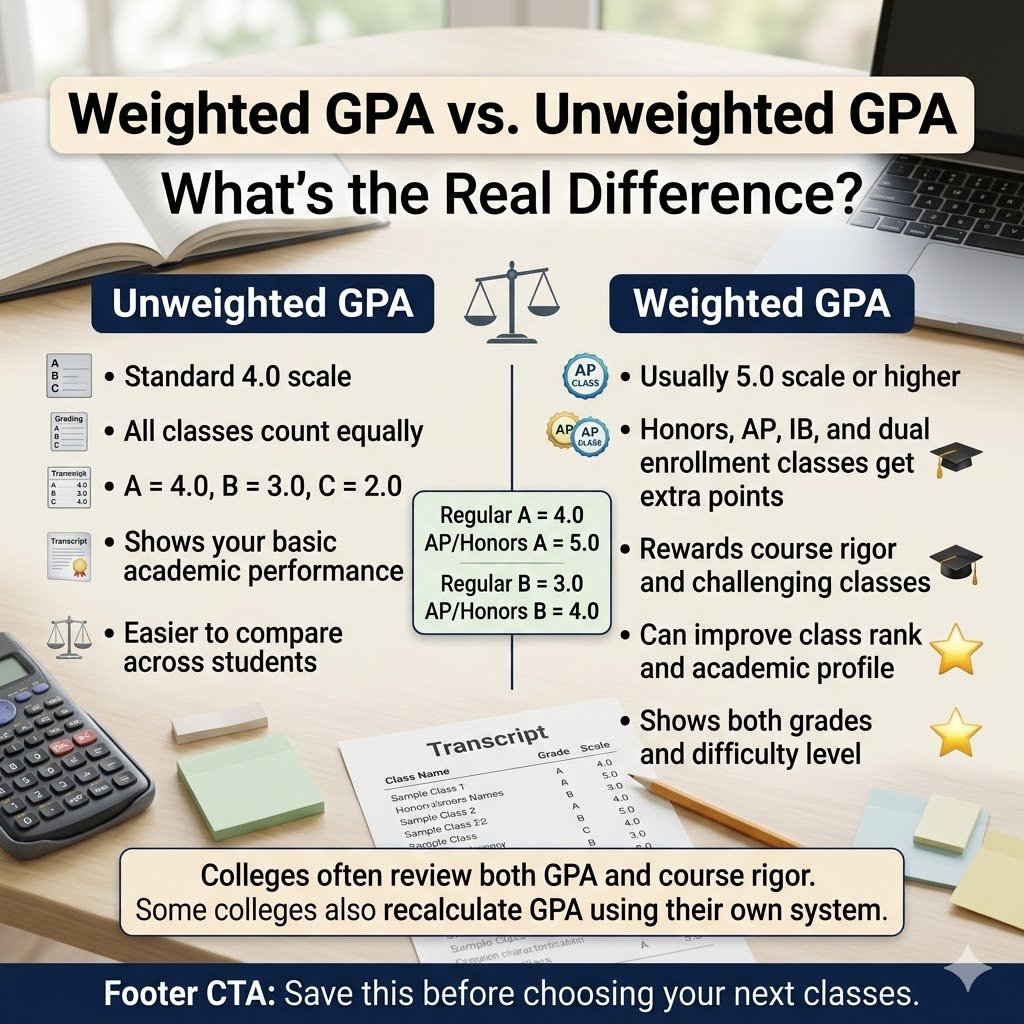
An unweighted GPA measures every course equally on a standard 4.0 scale, regardless of how difficult the class is. An A earns 4.0, a B earns 3.0, and so on across the board — whether the course is regular-level or the most challenging AP class your school offers.
A weighted GPA works differently. It adds bonus grade points to advanced courses to reflect their greater difficulty. Under the most common weighting system used in U.S. high schools:
- Regular courses — standard 4.0 scale (A = 4.0, B = 3.0, C = 2.0)
- Honors courses — receive a +0.5 bonus (A = 4.5, B = 3.5, C = 2.5)
- AP, IB, and Dual Enrollment courses — receive a +1.0 bonus (A = 5.0, B = 4.0, C = 3.0)
This means that on a weighted 5.0 scale, a student who earns an A in AP Biology has a grade point value of 5.0 for that course — higher than the 4.0 maximum on the unweighted scale. It’s possible, and common, for high-achieving students taking advanced coursework to carry a weighted GPA above 4.0.
The core purpose is fairness: weighted GPAs help admissions officers compare students across thousands of different schools and course selections by giving credit not just for grades, but for academic ambition.
Weighted GPA vs. Unweighted GPA: What’s the Real Difference?
The distinction between weighted and unweighted GPA is one of the most important — and most misunderstood — concepts in the entire college application process. Here’s how they differ in practice.
Consider two students, both with straight A’s:
- Student A takes all regular-level courses → Unweighted GPA: 4.0 / Weighted GPA: 4.0
- Student B takes four AP courses and two Honors courses → Unweighted GPA: 4.0 / Weighted GPA: ~4.8
Both students earned the same grades. But Student B’s weighted GPA signals something the unweighted number cannot: she took the hardest classes available and still performed at the highest level. That context matters enormously in selective college admissions.
Here’s a side-by-side comparison of how the two scales work:
| Course | Grade | Unweighted Points | Course Type | Weighted Points |
|---|---|---|---|---|
| English 11 | A | 4.0 | Regular | 4.0 |
| AP U.S. History | A | 4.0 | AP (+1.0) | 5.0 |
| Honors Pre-Calculus | B | 3.0 | Honors (+0.5) | 3.5 |
| AP Chemistry | B | 3.0 | AP (+1.0) | 4.0 |
| Spanish III | A | 4.0 | Regular | 4.0 |
Unweighted GPA: 3.6 | Weighted GPA: 4.1
The 0.5-point difference tells the story of a student who pushed into advanced coursework. That gap is exactly what the weighted scale is designed to communicate.
Both GPAs appear on your academic transcript, and most colleges look at both. Your unweighted GPA reflects pure grade performance. Your weighted GPA reflects the challenge level you chose. Neither one alone tells the complete story.
How to Calculate Weighted GPA — The Formula Explained
Understanding the math behind your GPA helps you use our calculator more effectively and interpret your results with confidence. Here’s how the calculation works.
Step 1: Assign grade points to each course
Start with the standard letter-grade-to-point conversion, then apply the weighting bonus based on course type:
| Letter Grade | Regular | Honors (+0.5) | AP / IB / Dual Enrollment (+1.0) |
|---|---|---|---|
| A+ / A | 4.0 | 4.5 | 5.0 |
| A− | 3.7 | 4.2 | 4.7 |
| B+ | 3.3 | 3.8 | 4.3 |
| B | 3.0 | 3.5 | 4.0 |
| B− | 2.7 | 3.2 | 3.7 |
| C+ | 2.3 | 2.8 | 3.3 |
| C | 2.0 | 2.5 | 3.0 |
| D | 1.0 | 1.5 | 2.0 |
| F | 0.0 | 0.0 | 0.0 |
Step 2: Multiply grade points by credit hours
Each course carries a credit value — typically 1 credit per semester course, though lab courses or year-long classes may carry more. Multiply each course’s weighted grade points by its credit hours to get that course’s quality points.
Quality points = Weighted grade points × Credit hours
Step 3: Divide total quality points by total credit hours
Add up all your quality points across every course. Then divide by your total number of credit hours. The result is your weighted GPA.
Weighted GPA = Total quality points ÷ Total credit hours
Example calculation:
| Course | Credit Hours | Weighted Grade Points | Quality Points |
|---|---|---|---|
| AP English Literature | 1 | 5.0 (A) | 5.0 |
| Honors Calculus | 1 | 3.5 (B) | 3.5 |
| AP Biology | 1 | 4.0 (B) | 4.0 |
| Regular History | 1 | 4.0 (A) | 4.0 |
| Regular PE | 0.5 | 4.0 (A) | 2.0 |
| Total | 4.5 | — | 22.5 |
Weighted GPA = 22.5 ÷ 4.5 = 5.0
Our weighted GPA calculator handles all of this automatically the moment you enter your courses, grades, and course types. You’ll never need to do this by hand.
How to Use This Weighted GPA Calculator
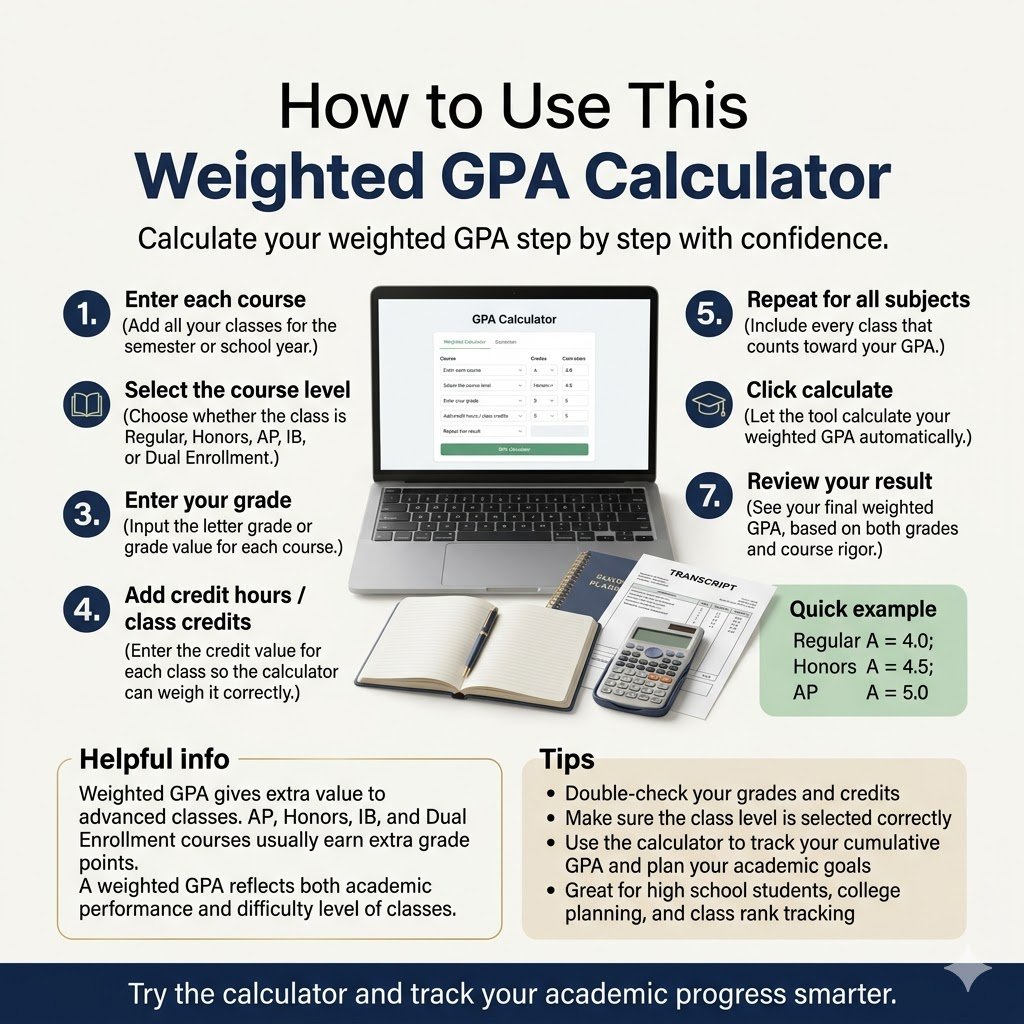
Using the calculator above takes less than two minutes. Here’s what to enter for accurate results:
1. Enter each course name — This is optional but helps you keep track of which classes you’ve added.
2. Select your letter grade — Choose the grade you earned (or expect to earn) for each course. The calculator converts it to grade points automatically.
3. Choose the course type — This is the most important field for weighted GPA. Select from Regular, Honors, AP/IB, or Dual Enrollment. This determines the weighting bonus applied to your grade.
4. Enter credit hours — Most semester-length high school courses are worth 1 credit. Labs or half-year electives may be 0.5. Check your report card or student handbook if you’re unsure.
5. Add more courses — Click “Add Course” to include every class from your current semester or all semesters if you’re calculating cumulative GPA.
6. View your results — The calculator instantly displays your weighted GPA, unweighted GPA, total credit hours earned, and total quality points accumulated.
Pro tip: To calculate your cumulative GPA across multiple semesters, enter all of your courses from every completed term together. The cumulative GPA reflects your entire high school academic record — which is what colleges see on your official transcript.
What Is a Good Weighted GPA?
Because weighted GPA can exceed the traditional 4.0 ceiling, the “good” threshold is higher than many students expect. Here’s a general benchmark based on the 5.0 scale:
| Weighted GPA | Academic Standing |
|---|---|
| 4.5 – 5.0 | Excellent — highly competitive for selective colleges |
| 4.0 – 4.4 | Strong — competitive for most four-year universities |
| 3.5 – 3.9 | Good — above average, competitive at many schools |
| 3.0 – 3.4 | Average — meets minimum requirements at many institutions |
| Below 3.0 | May need improvement for competitive college applications |
Keep in mind that a “good” GPA is always relative to your school’s course offerings, the number of advanced classes available, and the grading policies of your specific district. A 4.2 weighted GPA at a school with limited AP options may reflect stronger academic performance than a 4.5 at a school where most students take five AP courses per year.
Admissions officers are trained to read GPA in context — which is exactly why they look at the full transcript, not just the number.
Why Does Weighted GPA Matter for College Admissions?
When you apply to college, your GPA is one of the first things admissions officers evaluate. But they’re not just looking at the number — they’re reading your transcript line by line to understand the story behind it.
Here’s why your weighted GPA carries weight in the admissions process:
It rewards academic ambition. A student who earns a 3.8 weighted GPA while carrying four AP courses and two Honors courses is telling a different story than a student with a 3.8 from all regular classes. Both deserve recognition, but colleges use the weighted scale to identify students who sought out challenges.
It signals readiness for college-level coursework. Advanced Placement and IB courses follow college-level curricula set by the College Board and the International Baccalaureate Organization. A strong performance in these classes is direct evidence that a student is prepared for the rigor of higher education.
It helps colleges compare students fairly. Not all high schools are created equal. Some offer 25 AP courses; others offer three. Weighted GPA — combined with your school profile — helps admissions officers evaluate you relative to the opportunities available to you, not in a vacuum.
It may affect scholarship eligibility. Many merit scholarships set minimum GPA thresholds. Some use weighted GPA; others use unweighted. Knowing both of yours ensures you’re applying accurately and competitively.
Important: Many selective colleges recalculate your GPA using their own methodology when reviewing your application. The University of California system, for example, calculates a specific UC GPA using only core academic courses taken in 10th and 11th grade, capping weighted bonus points at eight semesters of AP/IB coursework. The Common App asks you to self-report your GPA, but colleges verify it against your official transcript. Always report the GPA from your actual report card — the number your school assigns.
How AP, Honors, and IB Courses Are Weighted
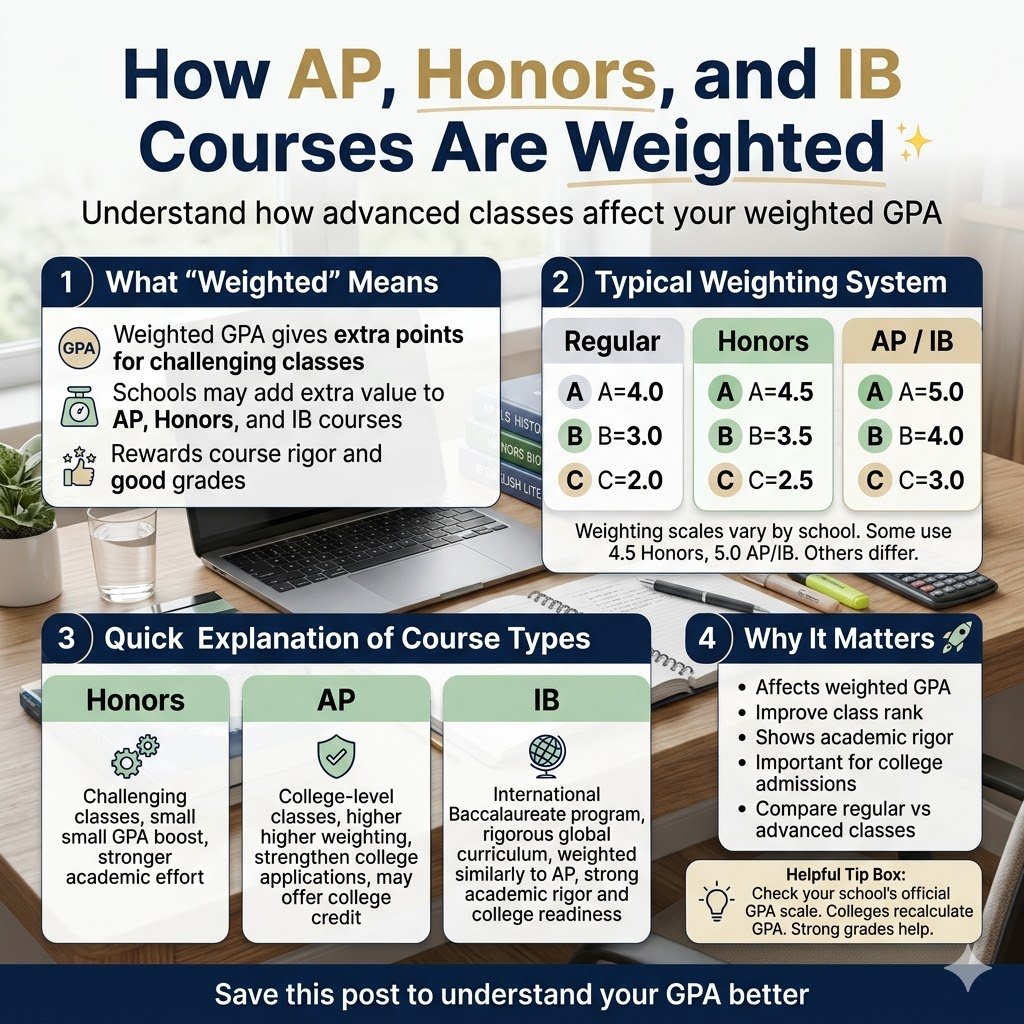
Not all advanced courses carry the same bonus. Here’s how the three main types of advanced coursework are typically weighted, along with what each represents academically.
Advanced Placement (AP) courses
AP courses are developed by the College Board and follow standardized curricula used across U.S. high schools. Because the content is consistent nationwide, admissions officers understand exactly what an “AP” label means on a transcript. Most schools award a full +1.0 bonus point for AP courses, placing them on the 5.0 scale.
Students who score 3 or higher on the AP exam at the end of the year may earn college credit or advanced placement at participating universities — making AP one of the most widely recognized ways to demonstrate college readiness.
Honors courses
Honors classes move at an accelerated pace and go deeper into the material than standard courses, but they follow a locally designed curriculum rather than a nationally standardized one. Most high schools award a +0.5 bonus for Honors courses, putting their grade scale at 4.5. The exact rigor can vary by school, which is why colleges typically view AP and IB as stronger signals of academic challenge than Honors alone.
International Baccalaureate (IB) courses
IB courses are part of the International Baccalaureate program, an internationally recognized framework often regarded as among the most rigorous options available to high school students. IB courses require extended essays, oral components, and holistic assessments that go beyond standard AP requirements. For GPA purposes, IB courses are usually weighted the same as AP courses, earning a +1.0 bonus. Some schools distinguish between IB Standard Level (SL) and IB Higher Level (HL), awarding a slightly larger bonus for HL courses.
Dual enrollment courses
Dual enrollment allows high school students to take actual college courses — usually through a local community college or university — while still in high school. These classes typically appear on both a high school transcript and a college transcript, and most schools weight them the same as AP/IB courses with a +1.0 bonus.
Semester GPA vs. Cumulative GPA — What’s the Difference?
Two GPA figures appear most often on your academic record, and it’s worth knowing how each is calculated and when it matters.
Semester GPA covers only the courses you took during a single term. It’s a snapshot of how you performed in that specific grading period. A strong semester GPA after a difficult stretch can show admissions officers an upward trend in your academic performance — which can be just as meaningful as a high overall number.
Cumulative GPA averages your grades across every completed semester from 9th through 12th grade. This is the number that appears most prominently on your official high school transcript and is the figure most colleges reference when reviewing applications. It reflects your entire academic journey, which is why a single difficult semester rarely defines a student — but a consistent trend, in either direction, tells a meaningful story.
Our calculator supports both. Enter only your current semester’s courses to see your semester GPA, or enter courses from all completed semesters together for an accurate cumulative weighted GPA.
Weighted GPA Across Different Grading Systems
The 5.0 weighted scale described throughout this guide is the most common in the United States, but it isn’t universal. Grading systems vary by school district, state, and country. Here are a few important variations to be aware of:
Standard U.S. weighted scale (5.0 max): AP/IB = +1.0, Honors = +0.5. This is the default used by most public high schools and the system our calculator uses.
University of California (UC) system: The UC GPA is a specialized calculation used during the application process. It considers only core academic courses (A–G requirements) from 10th and 11th grade, applies the standard +1.0 weighting for AP/IB and dual enrollment courses only (Honors courses are not weighted in the UC formula), and caps extra points at eight semesters. Students applying to UC schools should be aware that their UC GPA will differ from their school-reported weighted GPA.
100-point percentage scale: Some high schools — particularly in New York, New Jersey, and parts of the Northeast — report grades as percentages rather than letter grades. Weighting in these systems may involve multiplying the percentage by a factor (such as 1.05 or 1.10) before averaging, rather than adding a fixed bonus point.
International systems: Canadian schools often use a 4.3 scale; Australian universities use a 7.0 scale; Indian CGPA systems use a 10.0 scale. Our calculator currently supports the standard U.S. 5.0 weighted scale.
If you’re unsure which scale your school uses, check your student handbook or ask your school counselor. Entering your grades on the correct scale is the most important step to getting an accurate result.
Tips to Improve Your Weighted GPA
Your GPA is not fixed. Every course you take going forward is an opportunity to raise your cumulative average. Here are practical strategies students use to improve their weighted GPA over time.
Take advanced courses strategically. Adding AP or IB courses to your schedule increases your potential GPA ceiling. Even a B in an AP class earns more grade points (4.0 weighted) than an A in a regular class (4.0 unweighted), so the weighting bonus can work in your favor even when a course is challenging. That said, don’t overload your schedule to the point where grades suffer across the board. One well-managed AP course is worth more than three poorly performed ones.
Prioritize core academic subjects. Most colleges, including the UC system, recalculate GPA using only core courses: English, mathematics, science, social studies, and foreign language. Strong performance in these subjects has a disproportionate impact on how colleges evaluate your academic record.
Monitor your semester GPA regularly. Use this calculator at the beginning and middle of each semester to run “what-if” scenarios. Enter expected grades to see how different outcomes will affect your cumulative weighted GPA — then use that projection to decide where to focus your energy.
Recover, don’t spiral. A single bad semester rarely defines a student’s academic story. An upward grade trend across junior and senior year is something admissions officers explicitly look for. If your GPA took a hit, the most important move is to demonstrate consistent improvement going forward.
Communicate with your school counselor. Counselors can help you understand exactly which courses count toward your school’s weighted GPA calculation, which classes are recognized as Honors or AP in your district’s grading policy, and how to plan your course load to maximize both your GPA and your readiness for college.
Frequently Asked Questions
Can a weighted GPA be higher than 4.0?
Yes. On a weighted 5.0 scale, students who earn high grades in AP, IB, or Dual Enrollment courses can achieve weighted GPAs above 4.0. The maximum possible weighted GPA depends on your school’s scale and the proportion of advanced courses in your schedule. Many high-achieving students at schools with robust AP programs carry weighted GPAs between 4.5 and 5.0.
Do colleges look at weighted or unweighted GPA?
Most colleges look at both, and they look at your full transcript. Your unweighted GPA tells admissions officers about your baseline grade performance. Your weighted GPA tells them whether you sought out challenging coursework. Neither number is reviewed in isolation — context always matters.
How many credit hours should I enter for each course?
The standard for a semester-length high school course is 1 credit hour. Year-long courses are typically 2 credits (or entered as two separate semester entries). Half-year electives or lab components are often 0.5 credits. When in doubt, check your transcript or report card — your school’s official credit values are the ones to use.
What happens if I enter a Pass/Fail course?
A Pass grade earns credit toward graduation but does not carry a grade point value, so it does not affect your GPA in either direction. A Fail is typically recorded as a 0.0 and will lower your GPA. Most GPA calculators, including ours, skip Pass/Fail courses entirely since they don’t contribute grade points.
Why does my weighted GPA differ from what my school reports?
Your school may use a slightly different weighting system — for example, some districts give a +0.5 bonus for AP instead of +1.0, or weight Honors courses differently. Always confirm your school’s exact weighting policy in your student handbook and enter the matching values into the calculator. Our tool allows you to enter any grade point value manually to match your school’s specific scale.
How do I calculate cumulative weighted GPA across multiple years?
Enter all courses from every completed semester together into the calculator. The cumulative GPA formula divides your total quality points across all semesters by your total accumulated credit hours. The result is your overall weighted GPA — the number that reflects your full high school academic record.
Does dual enrollment count toward my weighted GPA?
In most school districts, yes — dual enrollment courses are weighted the same as AP and IB courses, earning a +1.0 bonus. They also appear on a separate college transcript, which may carry additional weight during the admissions process. Check your district’s grading policy to confirm how dual enrollment is classified at your school.
Related Tools
- Final Grade Calculator — Determine the exact score you need on an upcoming exam to hit your target course grade.
- College GPA Calculator — Calculate your GPA using college-style credit hours and grading policies.
This calculator uses the standard U.S. weighted GPA scale with +1.0 for AP, IB, and Dual Enrollment courses and +0.5 for Honors courses. Results are estimates based on the inputs provided. Always verify your GPA against your official academic transcript. Last updated: June 2026.