Final Grade Calculator
Use this free final grade calculator to answer the two questions every student asks before finals week: “What do I need on my final exam to get the grade I want?” and “What will my overall course grade be?” Enter your current grade, your target grade, and how much your final is worth, and the calculator does the weighted math for you.
Final Grade Calculator
Find the score you need on the final to hit your target grade.
Your grade before the final.Percent of your grade.Target course grade.You need on the final —Fill in all three fields to see the score you need on your final.
If you score… your course grade becomes
Final score Course grade Letter How the final grade is calculated
Your final course grade is a blend of everything so far and the final exam, in proportion to how much the final is worth. To find the score you need, the calculator rearranges that relationship to solve for the final.
Formula:needed = (target − current × (1 − w)) ÷ w, where w is the final’s weight as a decimal.Example: with an 84% going in, a final worth 30%, and a 90% target, you would need (90 − 84 × 0.7) ÷ 0.3 = 104% — out of reach, so the calculator shows the highest grade still possible instead.
Enter your current grade, how much the final is worth, and the grade you want. The calculator solves for the exact score that gets you there.
Then your target is not reachable with this final alone — even a perfect score would fall short. The note shows the highest course grade still possible.
Before. It is your standing in everything except the final exam itself.
- Grade I need on the final — inputs: current grade (%), desired final grade (%), final exam weight (%).
- My overall final grade — inputs: current grade (%), final exam score (%), final exam weight (%); plus an optional weighted-category mode.
Below the tool, you’ll find the exact formulas, step-by-step worked examples, and answers to the most common grading questions — including the difference between your final grade and your final exam grade, which trip up a lot of people.
What Grade Do I Need on My Final Exam?
This is the reverse calculation, and it’s the most useful one heading into finals. You already know your current grade (your weighted average so far), you know your target grade, and the syllabus tells you how much the final exam is worth. From those three numbers, you can work out the exact score you need on the final.
The logic is simple once you see it: everything you’ve already done is locked in and makes up part of your overall grade. The final exam fills in the rest. So the score you need depends on how big a gap there is between where you are and where you want to be — and on how much weight the final carries to close that gap.
The formula
Required final score = ( Target grade − Current grade × (1 − Final weight) ) ÷ Final weightWeights go in as decimals: a final worth 25% is 0.25, and the rest of your grade is 1 − 0.25 = 0.75.
Worked example
Say your situation looks like this:
- Current grade: 78%
- Final exam weight: 25% (so
0.25) - Target (desired) grade: 80%
Here’s the step-by-step:
- Convert the final’s weight to a decimal and find the rest of your grade:
1 − 0.25 = 0.75. - Multiply your current grade by that non-final portion:
78 × 0.75 = 58.5. - Subtract from your target grade:
80 − 58.5 = 21.5. - Divide by the final’s weight:
21.5 ÷ 0.25 = 86.
You need 86% on the final exam to finish the course with an 80% overall.
Notice that you need to score above your current average (78%) to raise it to 80%. That’s the part students often misjudge — a final that’s worth a lot can move your grade quickly in either direction.

How to Calculate Your Overall Final Course Grade
This is the forward calculation: you know (or are predicting) your final exam score, and you want your overall grade — also called your final course grade or semester grade.
Method 1: Current grade + final exam (the quick way)
If your current grade already represents everything except the final, you only need two pieces plus the final’s weight.
Final grade = ( Current grade × (1 − Final weight) ) + ( Final exam score × Final weight )Worked example
- Current grade: 85%
- Final exam score: 92%
- Final exam weight: 20% (
0.20)
- Non-final portion:
1 − 0.20 = 0.80. - Weight your current grade:
85 × 0.80 = 68. - Weight your final score:
92 × 0.20 = 18.4. - Add them:
68 + 18.4 = 86.4.
Your overall final grade is 86.4% — a B+ on most grading scales.
Method 2: Full weighted categories (when the final is just one of several)
If your syllabus breaks the course into weighted categories (homework, quizzes, midterm, participation, final exam), your overall grade is the weighted average of every category. Multiply each category score by its weight, then add the results. The weights must add up to 100%.
Final grade = Σ ( Category score × Category weight )Worked example
| Category | Your score | Weight | Weighted points (score × weight) |
|---|---|---|---|
| Homework | 95% | 10% | 9.5 |
| Quizzes | 88% | 15% | 13.2 |
| Midterm | 82% | 25% | 20.5 |
| Participation | 100% | 20% | 20.0 |
| Final exam | 90% | 30% | 27.0 |
| Total | — | 100% | 90.2% |
Add the weighted points: 9.5 + 13.2 + 20.5 + 20.0 + 27.0 = 90.2. Your final grade is 90.2%, an A− on a standard scale.
If your category weights don’t add up to 100% (for example, the final hasn’t happened yet and you only want your grade so far), divide your weighted total by the sum of the weights you actually used.
Final Grade vs. Final Exam Grade (They’re Not the Same Thing)
This is the single biggest point of confusion, so it’s worth being precise.
- Final exam grade is the score on one assessment: the final exam itself. It’s a single number, like 92%.
- Final grade (final course grade) is your overall grade for the entire term. It combines every assessment — homework, quizzes, the midterm, participation, and the final exam — each counted by its weight.
In other words, your final exam grade is one ingredient; your final grade is the finished dish. A great final exam score doesn’t guarantee a great final grade if the exam is only worth 15% and the rest of your semester was shaky. Likewise, you can sometimes secure a strong final grade even with a mediocre final, if your coursework was strong and the exam’s weight is small.
When you search “final grade calculator,” decide which one you actually need:
- To find the score you must earn on the exam → use the grade-needed mode (first section above).
- To find your overall course grade → use the overall grade mode (second section above).
Weighted Grading vs. Points-Based Grading
Before you trust any number, check which grading scheme your class uses, because the math differs.
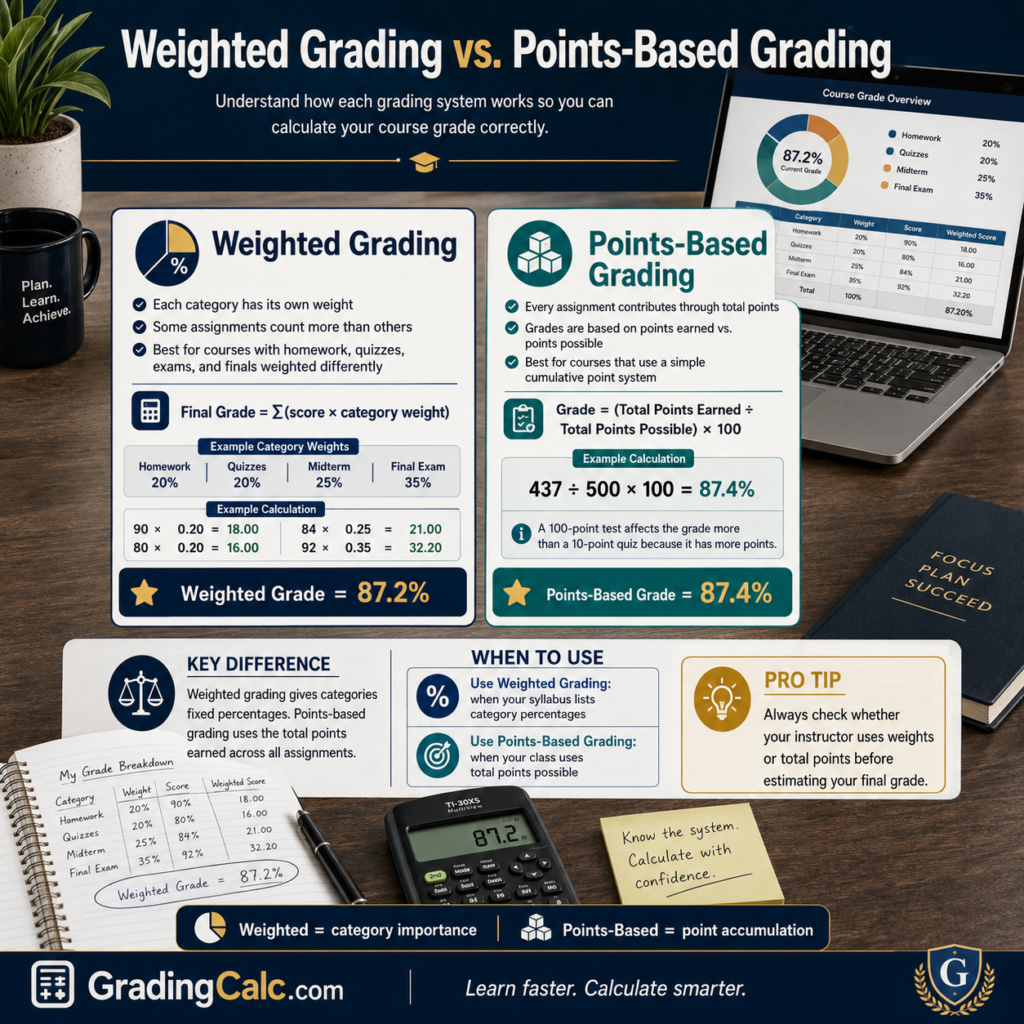
Weighted grading assigns each category a percentage of the final grade (quizzes 15%, final 30%, and so on). This is what both formulas above assume. Your category averages matter more than raw point totals, because a small category can’t swing your grade much regardless of how many points it contains.
Points-based grading ignores categories and simply totals points. Your grade is:
Grade = Points earned ÷ Points possible × 100Worked example (points-based): Before the final you’ve earned 380 out of 450 possible points. The final exam is worth 150 points and you score 120.
- Points earned:
380 + 120 = 500 - Points possible:
450 + 150 = 600 - Grade:
500 ÷ 600 × 100 = 83.3%
If your syllabus lists point values rather than percentages, use this points method. If it lists category weights, use the weighted method. Mixing them up is a common reason a homemade calculation disagrees with the gradebook.
Edge Cases Worth Knowing
The required score is above 100%. If the grade-needed formula returns something like 104%, the target isn’t reachable through the final exam alone. Your realistic options are extra credit (if offered), aiming for the next letter grade down, or talking to your instructor. The number isn’t “wrong” — it’s telling you the math doesn’t fit in a 0–100 exam.
The required score is very low (or negative). A result of, say, 12% — or a negative number — means you’ve essentially already secured your target grade, and even a poor final won’t drop you below it. You still have to take the exam, but the pressure is off.
Rounding. Does an 89.5% round up to an A? That depends entirely on your syllabus and instructor policy. Some round to the nearest whole percent, some don’t round at all, and some use plus/minus thresholds. Don’t assume rounding will rescue a borderline grade.
Extra credit. Extra-credit points are usually added on top of your earned total (points-based) or as a small bump to a category average (weighted). Add them before running the formula so your current grade reflects them.
Curved grades. A curve is applied after raw scores are calculated. These formulas give you the raw, pre-curve result. If your instructor curves, treat the output as a floor, not a final answer.
Drop-the-lowest policies. If your class drops your lowest quiz or homework, recompute that category’s average without the dropped score before plugging it in.
How to Calculate Your Final Grade in Excel or Google Sheets
You can reproduce every formula above in a spreadsheet.
Grade you need on the final (current 78%, weight 0.25, target 80%):
=(80-(78*0.75))/0.25 → returns 86Overall grade, quick method (current 85%, final 92%, weight 0.20):
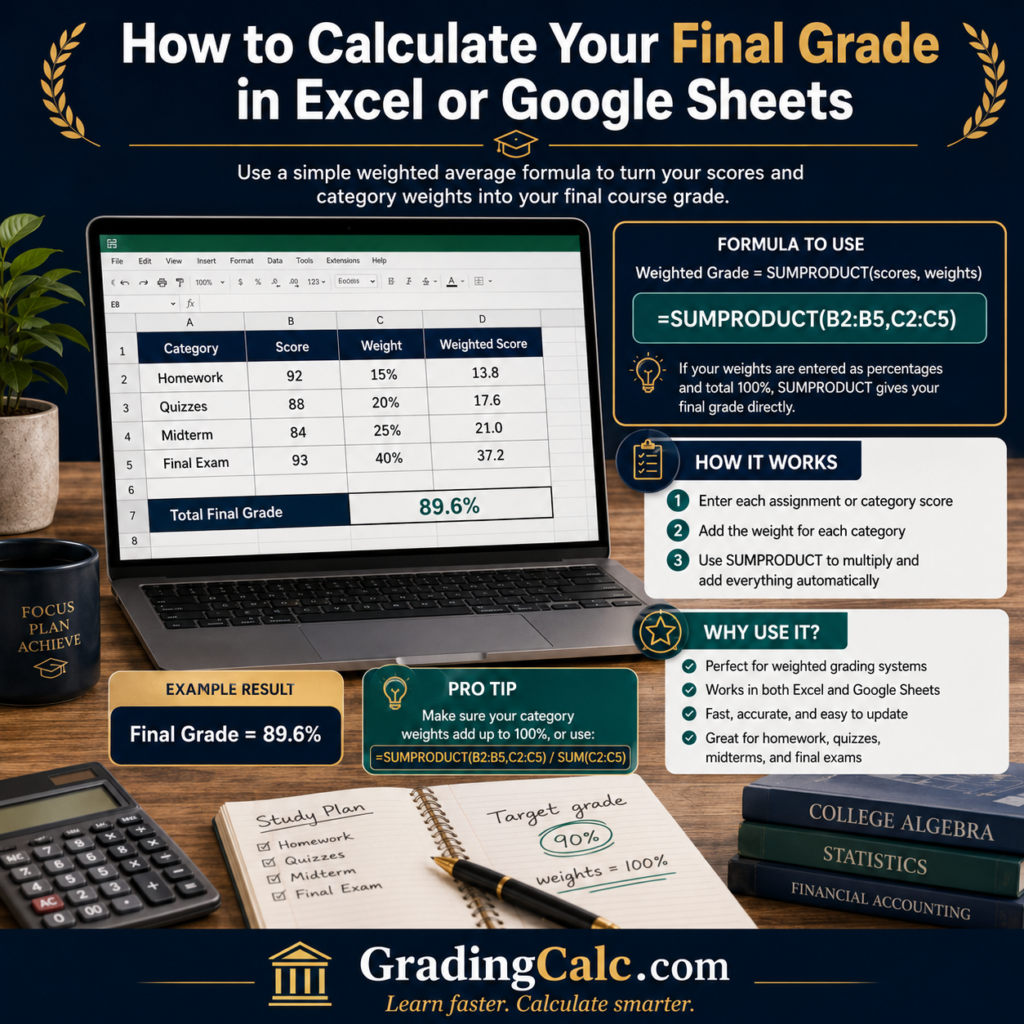
=(85*0.8)+(92*0.2) → returns 86.4Overall grade, weighted categories — put your category scores in B2:B6 and their weights (as decimals that sum to 1) in C2:C6:
=SUMPRODUCT(B2:B6, C2:C6)If your weights are percentages that don’t total 1, normalize them on the fly:
=SUMPRODUCT(B2:B6, C2:C6)/SUM(C2:C6)SUMPRODUCT multiplies each score by its weight and adds the results in one step — the exact definition of a weighted average.
Frequently Asked Questions
What grade do I need on my final to get an A?
Use the required-score formula with your target set to the A threshold (often 90%). Subtract your current grade times the non-final portion from that threshold, then divide by the final’s weight. If the answer comes out above 100%, an A isn’t reachable through the exam alone.
How do I calculate my final grade?
Multiply each weighted category (including the final exam) by its weight and add the results, making sure the weights total 100%. If your current grade already covers everything but the final, you can shortcut it: current grade × (1 − final weight) + final score × final weight.
How much is my final exam worth?
Check your syllabus — the weight is set by your instructor and varies widely, commonly anywhere from 10% to 40% of the final grade. That percentage is exactly the “final weight” you plug into the formulas.
How much will my final affect my grade?
The bigger the final’s weight, the more it moves your grade. A final worth 30% can shift your overall grade by several points in either direction; one worth 10% can barely nudge it. The calculator shows the exact effect for your numbers.
What will my grade be if I get a certain score on the final?
Use the overall-grade mode: enter your current grade, the score you’re predicting on the final, and the final’s weight. The result is your projected final course grade for that scenario. Try a few scores to see your best and worst cases.
Can I still pass if I fail the final exam?
Sometimes. Run the overall-grade formula using a low final score and see whether the result stays at or above your passing threshold. If your coursework is strong and the final’s weight is small, passing is still possible even with a weak final.
How do I calculate my final grade with weighted categories?
List every category, its average, and its weight, then multiply each average by its weight and total them. Confirm the weights add to 100%. A spreadsheet with SUMPRODUCT handles this in one cell.
What’s the difference between my final grade and my final exam grade?
Your final exam grade is the score on the exam itself — one assessment. Your final grade is your overall course grade for the whole term, combining all assessments by weight. The exam grade is part of the final grade, not the same as it.
How do I calculate my semester or overall grade?
It’s the same weighted-average calculation as your final grade: every category multiplied by its weight, summed together. “Semester grade,” “overall grade,” and “final course grade” all refer to this single weighted result.
Results from this final grade calculator are estimates based on the numbers you enter. Always confirm your official grade against your syllabus and your instructor’s gradebook, since rounding, curves, and drop policies can change the outcome.