Cumulative GPA Calculator — Calculate Your Overall Grade Point Average
Whether you’re tracking your academic progress, preparing a college application, or trying to stay eligible for a scholarship, knowing your cumulative GPA is essential. Use our free online cumulative GPA calculator to instantly find your overall grade point average across every semester you’ve completed — no math required.
Cumulative GPA Calculator
Roll multiple terms into one overall cumulative GPA.
Add each term’s GPA and its credit hours to see your cumulative GPA.
How cumulative GPA works
A cumulative GPA combines several terms into one figure, weighting each term by the credits it carried. A heavier term pulls the overall number toward its own GPA.
cumulative = Σ(term GPA × credits) ÷ Σ(credits)Example: a 3.50 across 15 credits and a 3.80 across 15 credits give (3.50 × 15 + 3.80 × 15) ÷ 30 = 3.65. Enter one row per term — semester or year, whichever you track.
Multiply each term’s GPA by the credits taken that term, add the results, and divide by the total credits across all terms.
Yes, as long as each row’s credits match that period. Use one row per term and enter the GPA and credits for it.
That is handled automatically — terms with more credits count proportionally more toward your cumulative GPA.
What Is a Cumulative GPA?
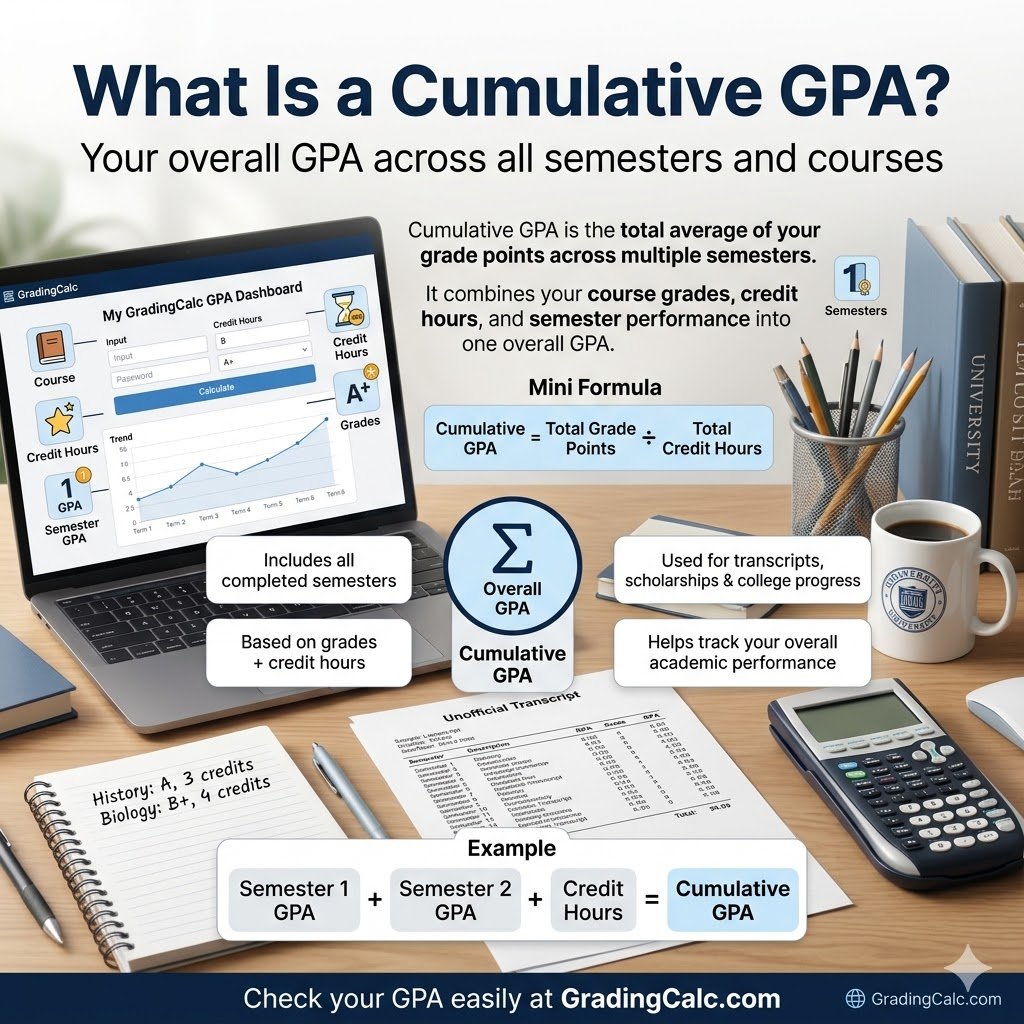
Your cumulative GPA is the overall grade point average of every graded course you’ve taken throughout your academic career at an institution. Unlike your semester GPA — which only reflects performance in a single term — your cumulative GPA combines all of your completed semesters into one unified metric.
Schools calculate it using a weighted average formula: each letter grade you earn is converted into a numerical value (called grade points), multiplied by the credit hours that course carries (known as quality points), and then divided by your total credit hours attempted.
Here’s the simple GPA formula:
Cumulative GPA = Total Quality Points ÷ Total Credit Hours
For example, if you earned an A (4.0) in a 3-credit course and a B (3.0) in a 4-credit course, your quality points are (4.0 × 3) + (3.0 × 4) = 24. Divide by 7 total credit hours and your GPA is approximately 3.43.
Most U.S. colleges and high schools use an unweighted 4.0 scale, where an A = 4.0, B = 3.0, C = 2.0, D = 1.0, and F = 0. Institutions that offer AP courses, IB courses, or honors courses may use a weighted GPA system, where advanced coursework can earn up to 5.0 grade points, reflecting the increased difficulty level.
How to Use This Cumulative GPA Calculator
Our multi-semester GPA calculator is designed to be fast and student-friendly. Here’s how to get your result in under a minute:
- Enter your course name (optional, but helpful for tracking).
- Select your letter grade from the dropdown — the calculator supports the full A+ through F scale, including plus/minus grading.
- Enter the credit hours for that course. Most college classes are 3–4 credit units; labs or electives are often 1–2.
- Add more courses using the “+ Add Course” button. You can enter classes from multiple semesters to calculate your running GPA.
- View your result — the calculator updates your cumulative grade point average in real time.
If you already have a current GPA from previous terms, you can enter it along with your total attempted credit hours to factor it into the calculation. This is especially useful for students mid-semester who want to project how new grades will affect their overall standing.
Understanding the GPA Scale
| Letter Grade | Grade Points | Common Percentage Range |
|---|---|---|
| A+ / A | 4.0 | 93–100% |
| A− | 3.7 | 90–92% |
| B+ | 3.3 | 87–89% |
| B | 3.0 | 83–86% |
| B− | 2.7 | 80–82% |
| C+ | 2.3 | 77–79% |
| C | 2.0 | 73–76% |
| C− | 1.7 | 70–72% |
| D+ | 1.3 | 67–69% |
| D | 1.0 | 60–66% |
| F | 0.0 | Below 60% |
Grades marked as Pass (P), No Pass (NP), Incomplete (I), or Withdrawal (W) are typically excluded from the GPA calculation, meaning they don’t raise or lower your average — though W grades may still appear on your transcript.
Weighted vs. Unweighted GPA: What’s the Difference?
One of the most common sources of confusion for students is the distinction between weighted and unweighted GPA.
An unweighted GPA treats all courses equally on the standard 4.0 scale. A student who earns an A in an introductory elective and an A in an AP calculus class both receive 4.0 quality points per credit hour.
A weighted GPA rewards tougher courses with extra points. Under a typical weighted system, an A in an honors course might be worth 4.5, and an A in an AP or IB course might count as 5.0. This gives colleges a clearer picture of a student’s academic rigor, not just their raw grade conversion.
When using our calculator, you can toggle between standard, honors, and AP/IB course weights to get the most accurate result for your specific grading system.
Why Your Cumulative GPA Matters
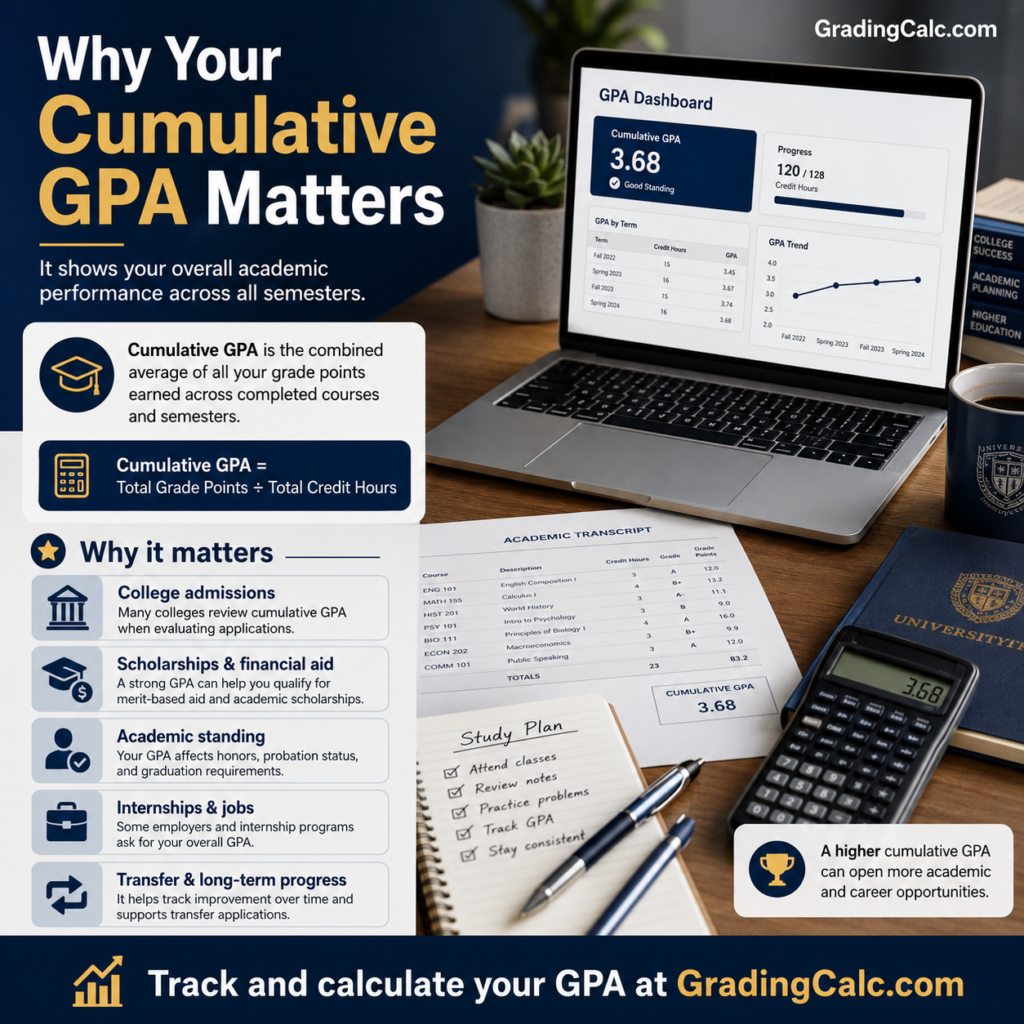
Your overall GPA is one of the most important academic metrics you’ll carry throughout your educational journey. Here’s where it shows up:
College Admissions
Colleges rely heavily on your high school cumulative GPA to gauge how likely you are to succeed in their academic environment. Most four-year universities look for a minimum GPA of 3.0, with selective schools often expecting 3.7 or higher. Your GPA is evaluated alongside other factors like test scores, extracurriculars, and essays, but it remains a primary indicator of academic consistency.
Scholarships & Financial Aid
Most scholarship programs and financial aid packages require students to maintain a minimum GPA — often 2.5 to 3.5 depending on the award. Falling below the threshold can put your funding at risk. Monitoring your cumulative GPA with a grade planner helps you stay ahead of those requirements before a single bad semester becomes a costly problem.
Graduate School Applications
Whether you’re applying to medical school, law school, or an MBA program, graduate admissions committees scrutinize your cumulative college GPA closely. Many programs publish a minimum GPA cutoff, and competitive applicants typically fall well above it. Knowing your running GPA throughout your undergraduate years gives you time to course-correct.
Academic Standing at Your Institution
Colleges use your cumulative GPA to determine your academic standing each semester. A GPA above 3.7 often qualifies you for the Dean’s List. Maintaining a GPA between 3.5 and 4.0 may make you eligible for graduation honors like magna cum laude or summa cum laude. Dropping below a 2.0 can place you on academic probation or, in severe cases, lead to academic dismissal. Many programs also require a minimum GPA within your major — known as your major GPA — to continue in the program.
Employment
Some employers — particularly in finance, consulting, and government — include a GPA requirement in job and internship listings, typically 3.0 or higher. Knowing your cumulative GPA before submitting applications helps you target the right opportunities with confidence.
How to Raise Your Cumulative GPA
If your current GPA isn’t where you want it to be, the good news is that it’s always possible to improve — it just takes strategic planning and consistency.
Understand the math first. Because your cumulative GPA is a weighted average across all your credit hours, earlier semesters carry significant influence. The more credits you’ve completed, the harder (and slower) it is to move the needle with just one semester’s performance. Use our GPA improvement calculator to set a realistic target GPA and find out exactly what grades you need in future terms to get there.
Prioritize high-credit courses. A 4-credit course has twice the GPA impact of a 2-credit elective. Earning a strong grade in a core course contributes far more quality points than doing the same in a lower-credit lab.
Consider a course retake. Many schools offer grade replacement policies, where retaking a course and earning a higher grade replaces the original in your GPA calculation. If your institution has this option, focusing on grade replacement in courses where you performed poorly can yield meaningful GPA improvement.
Manage your course load wisely. Taking on too many difficult courses at once increases the risk of grade drops across the board. A well-balanced semester — mixing challenging coursework with manageable ones — keeps your academic performance tracker trending upward.
Stay ahead of academic probation. If your GPA drops below 2.0, most institutions place you on academic probation, with a fixed timeline to recover your satisfactory academic progress. Acting early — before that threshold — gives you far more flexibility.
Cumulative GPA vs. Semester GPA: Key Differences
| Semester GPA | Cumulative GPA | |
|---|---|---|
| What it measures | One term only | All completed terms |
| When it resets | Every semester | Never — it accumulates |
| What it affects | Term honors, course load | Graduation, standing, applications |
| How it’s calculated | Quality points ÷ term credit hours | Total quality points ÷ total credit hours |
| Best used for | Tracking current-term performance | Long-term academic planning |
Your semester GPA is a useful short-term signal, but your cumulative GPA is the number that colleges, employers, graduate schools, and scholarship committees actually rely on.
Frequently Asked Questions
Does cumulative GPA include all semesters?
Yes. Your cumulative GPA is the average of every graded course you’ve taken at your institution across all terms — freshman year through your current semester. Courses marked as pass/fail, withdrawal, or incomplete are typically excluded from the calculation.
What is considered a good cumulative GPA?
A GPA of 3.0 or above is generally considered good academic standing at most colleges. A 3.5 or higher is often viewed as strong and can open doors to honors programs, competitive internships, and graduate school consideration. A 3.7+ frequently qualifies students for the Dean’s List or graduation with honors.
Can one bad semester ruin my cumulative GPA?
It can lower it, but not ruin it — especially if you’ve accumulated a large number of credit hours. The more total credits you have, the less impact a single term has on your overall GPA. That said, the sooner you address a grade dip, the more time you have to recover it through future academic performance.
What’s the difference between cumulative GPA and major GPA?
Your cumulative GPA reflects all of your graded coursework across every subject. Your major GPA counts only the courses within your declared major. Some graduate programs and employers specifically ask for your major GPA, as it more precisely measures your expertise in a specific field.
How many credit hours does it take to raise my GPA?
It depends on your current GPA and how far you want to raise it. Generally, the more credit hours you’ve already completed, the more future credits you need to earn high grades in to see a meaningful shift. Our target GPA calculator can run this projection for you automatically.
Does retaking a course help my cumulative GPA?
It depends on your school’s policy. Under grade replacement rules, the new grade replaces the original in your GPA calculation, which can meaningfully raise your cumulative GPA. Under averaging policies, both grades are counted. Always check your institution’s academic catalog before planning a course retake.
Tips for Accurate GPA Calculation
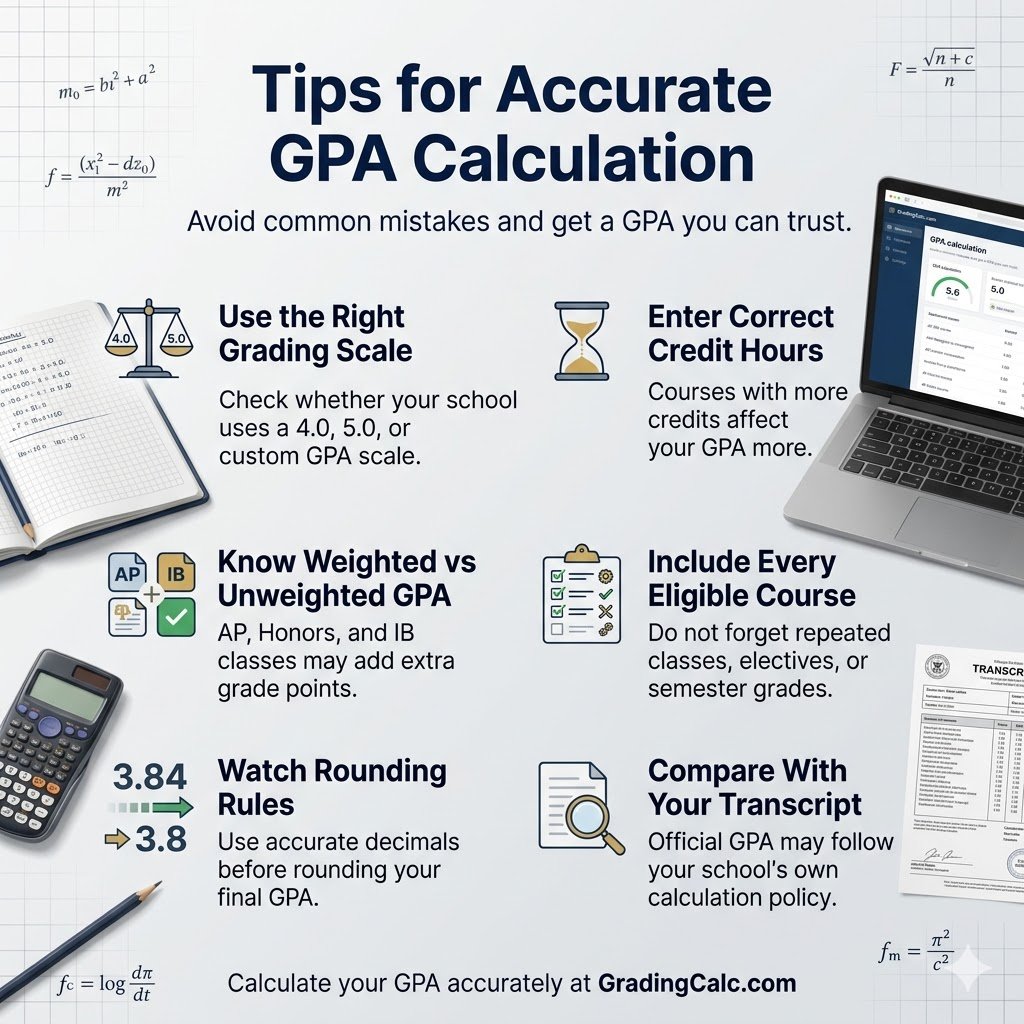
- Include every graded semester, even early ones where performance was lower — they all count toward your cumulative figure.
- Double-check credit hours for each course. Labs, studios, and seminars sometimes carry different credit units than standard lecture classes.
- Use the right grade scale for your school. Some institutions use a 4.3 scale (where A+ = 4.3); others cap at 4.0. Select the correct scale in the calculator settings.
- Update your tracker each term. Your cumulative GPA is a living number. Checking it only at graduation leaves you with little time to act on what you find.
GPA policies vary by institution. Always verify grade conversion rules, credit hour policies, and grade replacement eligibility with your college’s official academic catalog or registrar’s office. This calculator is intended as a planning tool and may not reflect your institution’s exact calculation method.