College GPA Calculator: Calculate Your Semester & Cumulative GPA (Free Tool)
College GPA Calculator
Built for credit-hour courses and semester reporting.
Add a letter grade and credit hours on any row to see your GPA.
How college GPA is calculated
Your GPA is a credit-weighted average of your grade points. Each course’s points are multiplied by its credit hours, those totals are added together, and the sum is divided by the total number of credits — so heavier courses move your GPA more.
GPA = Σ(points × credits) ÷ Σ(credits)Example: an A in a 3-credit class (4.0 × 3), a B+ in 4 credits (3.3 × 4), and an A- in 3 credits (3.7 × 3) give 36.3 ÷ 10 = 3.63. Turn on the weighted toggle to add Honors (+0.5) and AP/IB (+1.0) bonuses.
Multiply each course’s grade points by its credit hours, add those up, and divide by the total credit hours. An A in a 3-credit class contributes 4.0 × 3 = 12 grade points.
Honors and AP/IB courses earn extra points — commonly +0.5 and +1.0 — so a weighted GPA can rise above 4.0. Flip the toggle to switch between weighted and unweighted.
Yes. Use Save to keep them in this browser and Load to bring them back later. Nothing is uploaded — the data stays on your device.
What Is a College GPA? (Grade Point Average Explained)
Your grade point average (GPA) is a single number that summarizes your academic performance across all the courses you’ve taken in college. It is the most universally recognized measure of academic achievement used by universities, scholarship committees, graduate schools, and employers in the United States.
GPA is calculated on a 4.0 scale — though some institutions use a 5.0 scale for weighted courses. Every letter grade you earn in a class gets converted into a grade point value, which is then multiplied by that course’s credit hours to produce what are called quality points. Add up all your quality points, divide by your total credit hours attempted, and you have your GPA.
It sounds simple, and it is — once you understand the mechanics. That’s exactly what this page is designed to help you do: calculate your GPA instantly, understand how it works, and take informed action to protect or improve it.
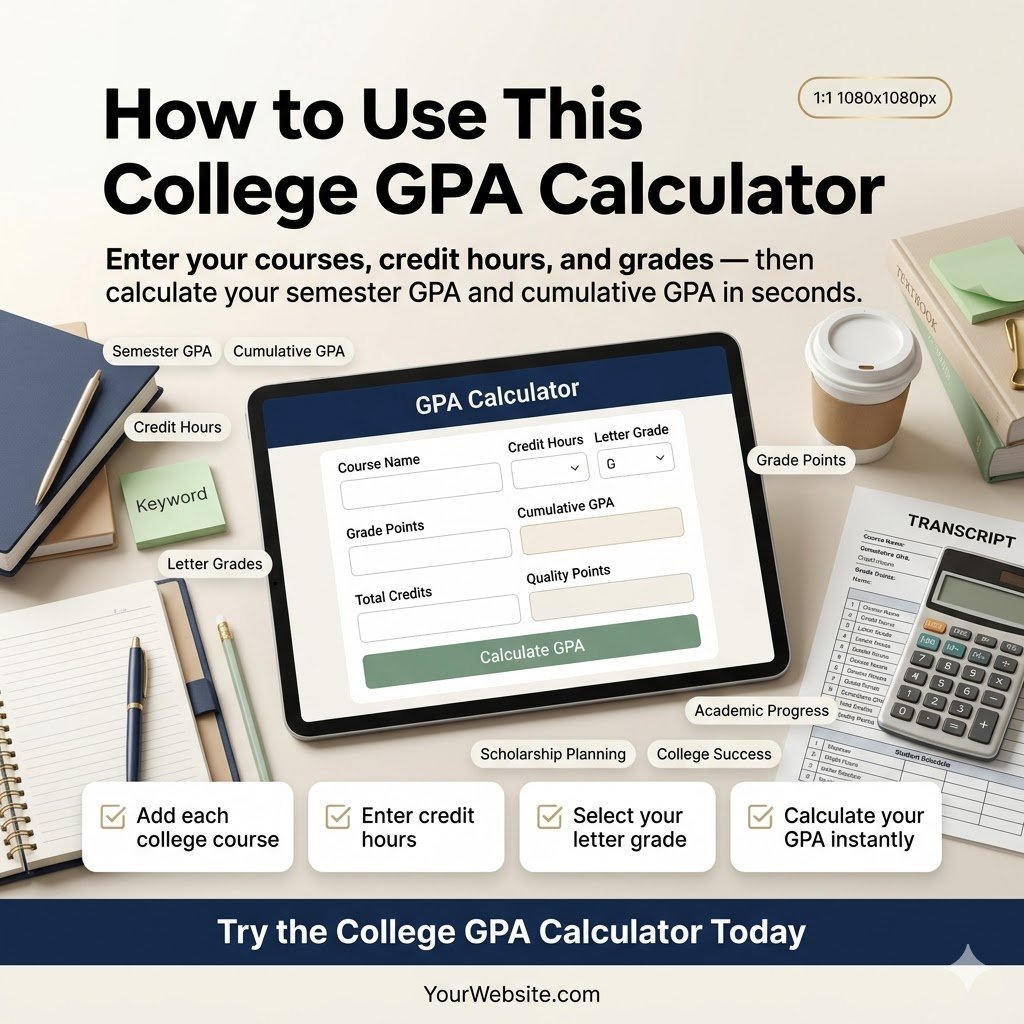
How to Use This College GPA Calculator
Using the calculator is straightforward:
- Enter each course name (optional, but helps you stay organized).
- Select the letter grade you earned — from A+ down to F.
- Enter the credit hours for that course (most college courses are 3 or 4 credits; labs and electives are often 1–2).
- Add all courses for the semester, then repeat for additional semesters.
- Your semester GPA and cumulative GPA update automatically in real time.
The calculator follows the standard U.S. grading system used by most colleges and universities, with grades weighted by credit hours — exactly how your university registrar computes the GPA that appears on your academic transcript.
The GPA Formula: How College GPA Is Calculated
The formula every university registrar uses to calculate your GPA is:
GPA = Total Quality Points ÷ Total Credit Hours Attempted
And quality points for each course are calculated as:
Quality Points = Grade Point Value × Credit Hours
Letter Grade to Grade Point Conversion (4.0 Scale)
| Letter Grade | Grade Point Value |
|---|---|
| A+ | 4.0 (some schools: 4.3) |
| A | 4.0 |
| A− | 3.7 |
| B+ | 3.3 |
| B | 3.0 |
| B− | 2.7 |
| C+ | 2.3 |
| C | 2.0 |
| C− | 1.7 |
| D+ | 1.3 |
| D | 1.0 |
| D− | 0.7 |
| F | 0.0 |
Note: Pass/Fail (P/NP), Incomplete (I), and Withdrawal (W) grades are not assigned grade point values and are excluded from your GPA calculation. You earn credits for a Pass, but no grade points are recorded.
GPA Calculation Example
Suppose you took these four courses in one semester:
| Course | Letter Grade | Grade Points | Credit Hours | Quality Points |
|---|---|---|---|---|
| English 101 | A | 4.0 | 3 | 12.0 |
| Calculus I | B+ | 3.3 | 4 | 13.2 |
| Introduction to Psychology | A− | 3.7 | 3 | 11.1 |
| Biology Lab | C+ | 2.3 | 1 | 2.3 |
- Total Quality Points: 12.0 + 13.2 + 11.1 + 2.3 = 38.6
- Total Credit Hours: 3 + 4 + 3 + 1 = 11
- Semester GPA: 38.6 ÷ 11 = 3.51
Notice how the 4-credit Calculus course carries significantly more weight than the 1-credit Biology Lab. This is why credit weight matters so much — earning a high grade in a high-credit core subject has a larger positive impact on your GPA than earning the same grade in a low-credit elective.
Semester GPA vs. Cumulative GPA: What’s the Difference?
These two metrics measure different things, and understanding the distinction is critical for academic planning.
Semester GPA (also called term GPA) reflects your academic performance in a single term only. It gives you a snapshot of how you performed that semester — useful for tracking progress or identifying a rough patch — but it carries no weight on its own beyond that term.
Cumulative GPA (CGPA) is the aggregate of all your grades across every completed semester. It accounts for every graded course you’ve ever taken at your institution, weighted by credit hours. This is the number that appears prominently on your academic transcript and the one colleges, graduate programs, scholarship committees, and employers actually use when evaluating you.
Think of semester GPA as a chapter grade and cumulative GPA as your final book score. A single bad semester is survivable — especially early in your college career when fewer total credits have accumulated — but it requires intentional recovery in subsequent terms.
Weighted GPA vs. Unweighted GPA in College
You may have heard these terms in high school, but they work a little differently in a college context.
Unweighted GPA treats all courses equally on the standard 4.0 scale. A B in an introductory elective carries the same grade point value as a B in an upper-division major course. Most colleges and universities report a single unweighted cumulative GPA on official transcripts.
Weighted GPA assigns extra grade point value to more challenging courses — typically Advanced Placement (AP), International Baccalaureate (IB), or Honors sections — to reflect their increased difficulty. A 5.0 scale is commonly used for weighted calculations at the high school level. In college, true weighted GPA is less common, though some graduate programs consider course rigor during admissions review.
For most undergraduate students, unweighted cumulative GPA on the 4.0 scale is the only figure that matters for academic standing, financial aid, and graduate school applications.
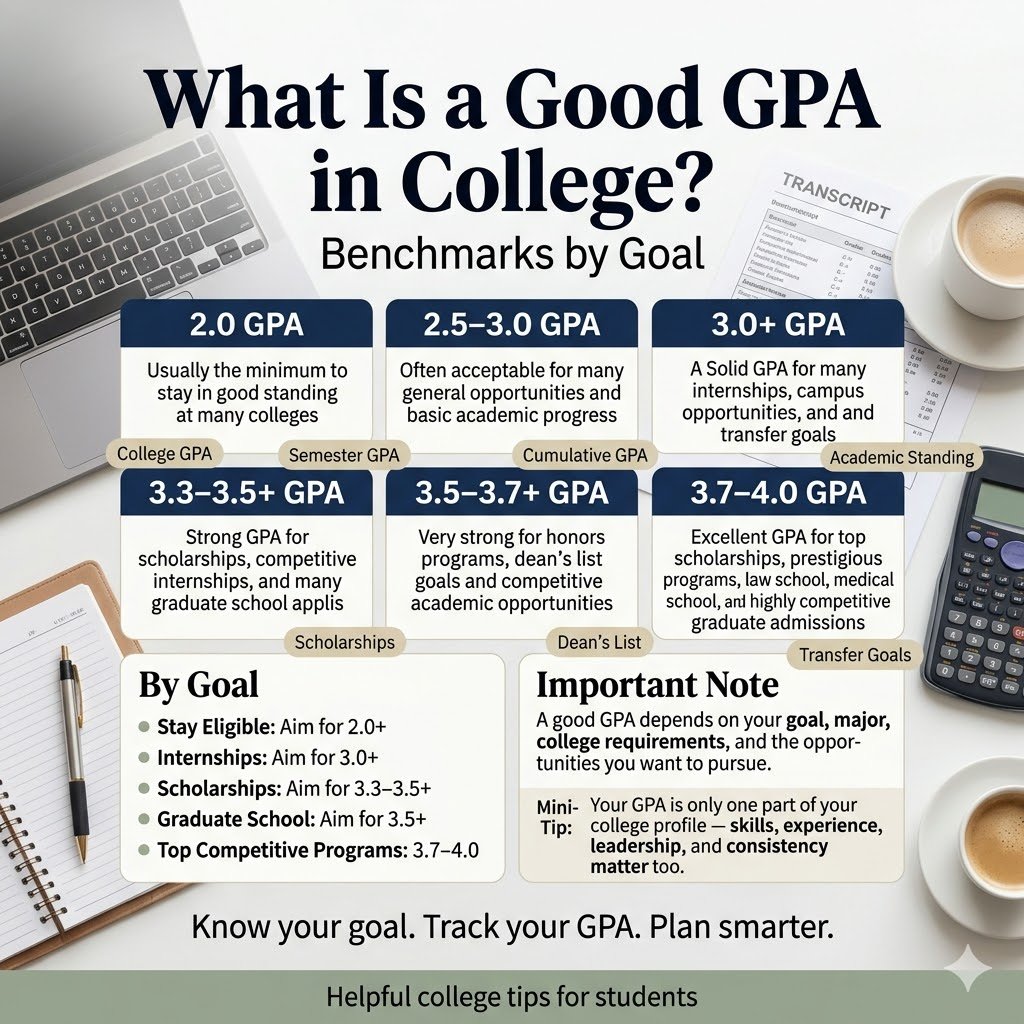
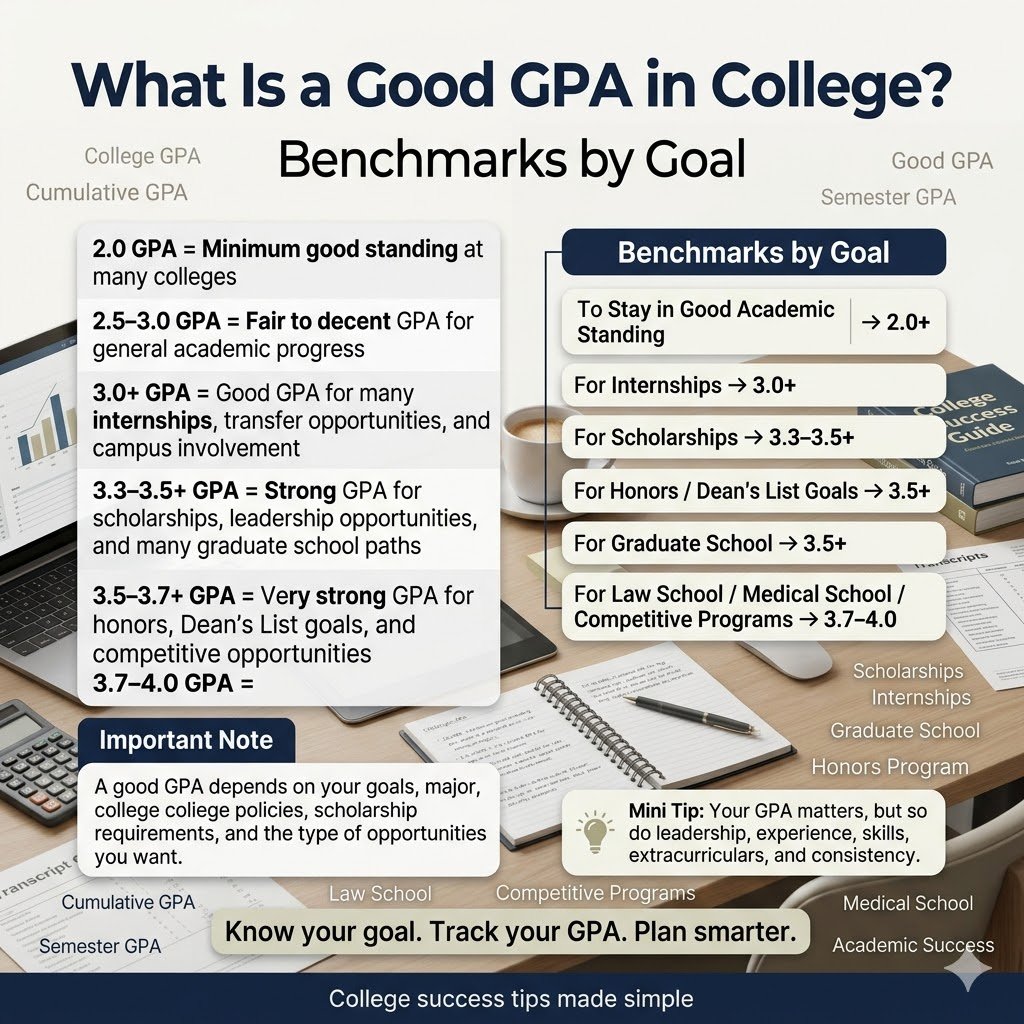
What Is a Good GPA in College? (Benchmarks by Goal)
GPA benchmarks vary depending on what you’re trying to achieve. Here’s how institutions and organizations typically evaluate your grade point average:
Academic Standing
- Below 2.0 GPA: Most colleges place students on academic probation, which can affect financial aid eligibility, campus housing, and degree progress. Continued grades below this threshold may lead to academic dismissal.
- 2.0 GPA: The minimum for good academic standing at most institutions, and the federal threshold for maintaining eligibility for financial aid (FAFSA GPA requirement).
- 3.0 GPA: Generally considered the baseline for solid academic performance. Required for entry into most honors programs and many competitive majors.
Scholarships & Awards
- 3.0–3.4 GPA: Minimum for most merit-based scholarships and departmental awards.
- 3.5 GPA: Competitive threshold for many institutional scholarships, Dean’s List eligibility, and need-based merit hybrid awards.
- 3.7+ GPA: Typically required for the highest academic distinctions.
Latin Honors at Graduation
Most U.S. colleges award Latin honors based on cumulative GPA at the time of graduation. While exact cutoffs vary by institution, common thresholds include:
- Cum Laude: ~3.5–3.6 GPA
- Magna Cum Laude: ~3.7–3.8 GPA
- Summa Cum Laude: ~3.9–4.0 GPA
Always verify exact GPA requirements with your university registrar, as cutoffs differ by school and sometimes by major.
Graduate School Applications
- 3.0 GPA: Minimum required by the majority of graduate programs.
- 3.5 GPA: Competitive for most master’s programs and selective professional schools.
- 3.7+ GPA: Strong position for top-tier graduate school admissions, GPA for law school applications, and many GPA for med school prerequisites.
Employment
Many competitive employers — particularly in finance, consulting, and law — set a GPA cutoff of 3.5 when screening undergraduate applications. If your GPA clears this threshold, it’s generally worth listing on your resume. Below 3.0, most career advisors recommend omitting it and leading with relevant skills and experience instead.
How Credit Hours Affect Your GPA (More Than You Think)
Understanding the relationship between credit hours and GPA is one of the most important — and most underappreciated — aspects of academic planning.
Because GPA is a credit-weighted average, a 4-credit course contributes four times as much to your cumulative GPA as a 1-credit elective. This creates two strategic realities:
1. A bad grade in a high-credit course is costly. Earning a C (2.0) in a 4-credit required course generates only 8 quality points, dragging your average down significantly more than the same C in a 1-credit lab.
2. Earning high grades in high-credit courses is the fastest way to raise your GPA. If you’re in a GPA recovery phase, prioritizing your performance in 3- and 4-credit courses delivers the most efficient return.
Most college courses carry 3 credit hours — the standard for a class meeting three hours per week. Labs, seminars, and physical education courses often carry 1–2 credits. Some upper-division or graduate-level courses may carry 4–5 credits.
When in doubt about a course’s credit value, check your course schedule documentation or contact your academic advisor.
Semester GPA and Cumulative GPA: A Multi-Semester Calculation
Once you’ve completed more than one semester, your cumulative GPA is not simply the average of your semester GPAs. Because different semesters involve different numbers of total credit hours, a simple average would be misleading.
The correct method: add up all quality points earned across every semester, then divide by all credit hours attempted across every semester.
Multi-Semester Example
| Semester | Quality Points | Credit Hours |
|---|---|---|
| Semester 1 | 42.0 | 14 |
| Semester 2 | 45.0 | 15 |
| Semester 3 | 48.5 | 16 |
| Total | 135.5 | 45 |
Cumulative GPA = 135.5 ÷ 45 = 3.01
This is precisely why the GPA calculator above lets you enter multiple semesters — so you get an accurate running cumulative GPA rather than an incorrect shortcut average.
How to Raise Your College GPA: Practical Strategies
If your current cumulative GPA isn’t where you want it, recovery is absolutely possible — but it requires understanding the math and being strategic.
1. Earn High Grades in High-Credit Courses
As covered above, a 4-credit course worth 16 quality points (A grade) moves your cumulative average far more efficiently than a 1-credit course worth 4. Build your schedule intentionally with this in mind.
2. Increase Your Total Credit Hours With Strong Grades
The more total credit hours you accumulate at high grades, the more earlier low grades are “diluted” in the cumulative calculation. This is a long game — one great semester alone won’t erase a difficult freshman year — but sustained strong performance compounds meaningfully over time.
3. Understand Your School’s Grade Replacement Policy
Some institutions allow students to retake a course, replacing the original grade in the GPA calculation with the new one. Others average both attempts. Others record both but only count the most recent. Before retaking any course with hopes of GPA improvement, verify your institution’s grade replacement policy with your university registrar.
4. Use the Target GPA Calculator
The GPA predictor feature in this calculator lets you reverse-engineer what grades you need in upcoming courses to hit a specific cumulative GPA. Rather than guessing, you can model scenarios — for example, “What semester GPA do I need this term to reach a 3.5 cumulative GPA by graduation?”
5. Don’t Overlook Withdrawal Strategy
A W (Withdrawal) on your transcript doesn’t affect your GPA, but it does affect your completion rate, which is a factor in satisfactory academic progress assessments for federal financial aid. If you’re struggling in a course, withdrawing before the deadline is often better than earning an F — but consult your academic advisor before making that decision.
6. Speak With Your Instructors Early
Many students wait too long to seek help. If you’re in academic difficulty mid-semester, your instructor may offer grade replacement opportunities, extra credit, or incomplete (I) grade arrangements that give you more time. An Incomplete grade, properly resolved, protects your GPA while allowing additional time to complete the work.
GPA Requirements for Scholarships, Financial Aid & Graduate School
Your cumulative GPA touches nearly every major academic and financial milestone in your college career.
Financial aid: The federal government requires students to maintain satisfactory academic progress (SAP) to remain eligible for financial aid under FAFSA. This includes a minimum cumulative GPA — typically 2.0 — as well as completion rate requirements. Falling below the minimum GPA requirement can result in suspension of federal loans, grants, and work-study eligibility.
Institutional scholarships: Most merit-based scholarships require you to maintain a minimum GPA — often 3.0 to 3.5 — each semester to retain the award. Many scholarship committees will review both semester and cumulative GPA when assessing renewal eligibility.
Honors programs: Honors program eligibility typically requires maintaining a cumulative GPA of 3.3 to 3.5, depending on the institution. Being removed from an honors program can affect course registration priority, special thesis opportunities, and certain graduate school credentials.
Transfer students: If you’re transferring to another institution, the receiving college will calculate a new GPA based on transferable coursework. Some credits may not transfer, and some institutions recalculate grades using their own internal scale, meaning your GPA for transfer students may differ from your home institution’s GPA.
Graduate school applications: Graduate admissions committees typically review your overall GPA and your upper-division GPA (junior/senior year) separately. A strong upward trend in grades — even from a rocky start — is viewed favorably. GPA for grad school is most competitive at 3.5 and above for most programs, though minimum requirements vary widely by program and institution.
GPA Calculation for International Students
International students applying to U.S. universities or scholarship programs are often required to convert their grades to the American 4.0 GPA scale. The conversion process varies by country, as grading systems differ significantly across education systems. Common scenarios include:
- Percentage-based systems (common in India, Pakistan, and parts of the Middle East): A percentage-to-GPA conversion chart is typically used, where scores above 90% map to 4.0, 80–89% to 3.0–3.9, and so on.
- Letter-grade systems that use different grade designations or cutoffs than the U.S. standard.
- Distinction/Credit/Pass systems used in some Commonwealth countries.
Most U.S. universities provide specific guidance on how international transcripts are evaluated. The university admissions or international student office is the authoritative source for conversion rules at each institution.
Does a Withdrawal (W) Affect Your GPA?
One of the most common questions students ask: does withdrawing from a course hurt your GPA?
The short answer is no — a W grade is not assigned any grade point value and is excluded entirely from your GPA calculation. You will not earn credits for the course, and no quality points are recorded. Your semester GPA and cumulative GPA remain unchanged.
However, a W does appear on your academic transcript and may be reviewed by graduate school admissions officers, scholarship committees, and some employers. Multiple withdrawals can signal difficulty with course management or academic persistence, so they should be used strategically rather than routinely.
More importantly, withdrawals affect your credit completion rate — one of the components of satisfactory academic progress. FAFSA requires students to complete a minimum percentage of attempted credits (often 67%) to maintain financial aid eligibility. Frequent withdrawals can put this ratio at risk.
Common GPA Questions Answered
What GPA does academic probation start at? At most U.S. colleges and universities, students whose cumulative GPA falls below 2.0 are placed on academic probation. The specific threshold and consequences vary by institution — some apply probation after a single low semester, others require the cumulative GPA to fall below the minimum. Check with your university registrar for the exact policy.
Does a Pass/Fail course affect my GPA? No. Pass (P) and No Pass (NP) grades are excluded from the GPA calculation at virtually all institutions. You earn credit hours for a passing grade, but no grade point value is recorded, so your cumulative GPA is unaffected.
Can I get a 4.0 GPA in college? Yes — a 4.0 cumulative GPA means earning an A in every graded course across all semesters. It’s a rare but achievable goal, particularly in programs with smaller course loads or at institutions that award a 4.0 for both A and A+ grades (rather than 4.3 for A+, which some schools cap at 4.0 on the cumulative scale regardless).
Should I include my GPA on a resume? Career advisors generally recommend listing your GPA on a resume if it’s 3.5 or higher, or if a specific job posting requests it. For GPA below 3.0, it’s typically better to omit it and focus on relevant experience and accomplishments instead.
How do I calculate my GPA without a calculator? Use the formula: multiply each letter grade’s grade point value by the course’s credit hours to get quality points, sum all quality points, sum all credit hours, and divide the first total by the second. The step-by-step GPA calculation is shown in the worked example earlier on this page.
What is a 3.5 GPA on a 4.0 scale in letter grade terms? A 3.5 GPA roughly corresponds to a solid B+/A− average across all your courses. It falls in the “strong” range for most academic and scholarship benchmarks, and is competitive for the majority of graduate programs.
Final Thoughts: Why Tracking Your GPA Matters
Your college GPA is more than just a number on a transcript — it’s a reflection of your academic journey and a practical credential that affects real outcomes: scholarship renewals, graduate school admission, financial aid eligibility, job applications, and your eligibility for honors at graduation.
Tracking your semester GPA and cumulative GPA in real time — rather than waiting for official grade reports — gives you the information you need to make smart decisions: which courses to prioritize, when to seek academic support, whether a course withdrawal is the right call, and exactly what grades you need to hit your academic goals.
Use the GPA calculator above to stay ahead of your academic standing, not just react to it. The students who consistently hit their GPA targets are the ones who know their numbers before the semester ends — not after.
This calculator uses the standard U.S. 4.0 GPA scale and letter grade conversion values recognized by most American colleges and universities. Grading scales and GPA policies vary by institution. Always verify GPA requirements and grade replacement policies directly with your university registrar or academic advisor.