High School GPA Calculator: Weighted & Unweighted GPA (Free Tool)
High School GPA Calculator
Tally a high-school GPA from class grades and credits.
Add a letter grade and credit hours on any row to see your GPA.
How high school GPA is calculated
Your GPA is a credit-weighted average of your grade points. Each course’s points are multiplied by its credit hours, those totals are added together, and the sum is divided by the total number of credits — so heavier courses move your GPA more.
GPA = Σ(points × credits) ÷ Σ(credits)Example: an A in a 3-credit class (4.0 × 3), a B+ in 4 credits (3.3 × 4), and an A- in 3 credits (3.7 × 3) give 36.3 ÷ 10 = 3.63. Turn on the weighted toggle to add Honors (+0.5) and AP/IB (+1.0) bonuses.
Multiply each course’s grade points by its credit hours, add those up, and divide by the total credit hours. An A in a 3-credit class contributes 4.0 × 3 = 12 grade points.
Honors and AP/IB courses earn extra points — commonly +0.5 and +1.0 — so a weighted GPA can rise above 4.0. Flip the toggle to switch between weighted and unweighted.
Yes. Use Save to keep them in this browser and Load to bring them back later. Nothing is uploaded — the data stays on your device.
What Is a High School GPA?
Your grade point average (GPA) is the single most important academic number on your high school transcript. It summarizes your academic performance across every course you’ve completed, converting letter grades into a consistent numerical score that colleges, scholarship programs, NCAA eligibility centers, and employers use to evaluate you.
High school GPA is calculated on a 4.0 scale — but unlike college GPA, it almost always involves two parallel numbers: your unweighted GPA, which treats every class equally on the standard 4.0 scale, and your weighted GPA, which assigns extra grade point value to advanced courses like AP, Honors, IB, and dual enrollment. Understanding both — and knowing when each matters — is essential for every student planning for college.
This free high school GPA calculator computes both your weighted and unweighted GPA simultaneously, supports all course types, and lets you track your cumulative GPA across every semester of your high school career.
How to Use This High School GPA Calculator
Getting your GPA takes under two minutes:
- Enter each course name to keep things organized (optional but helpful).
- Select your letter grade — from A+ down to F. If your school uses percentage grades, use the conversion guide below.
- Choose your course type — Regular, Honors, AP, IB, or Dual Enrollment. The calculator automatically applies the correct grade weighting for each.
- Enter your course credits — most high school courses carry 1 credit per year (or 0.5 per semester). Check your student handbook if you’re unsure.
- Add more semesters to build your full 4-year cumulative GPA.
Your semester GPA and cumulative GPA update in real time as you enter each course.

How High School GPA Is Calculated: The Formula
High schools calculate GPA using the same core formula used at the college level, with one critical addition: the weighting step for advanced courses.
The standard GPA formula is:
GPA = Total Quality Points ÷ Total Credits Attempted
And quality points for each course equal:
Quality Points = Grade Point Value × Course Credits
For weighted GPA, the grade point value is adjusted upward before this calculation is performed — adding +0.5 for Honors courses and +1.0 for AP, IB, or dual enrollment courses.
The Complete Grade Point Conversion Table
| Letter Grade | Regular (Unweighted) | Honors (+0.5) | AP / IB / Dual Enrollment (+1.0) |
|---|---|---|---|
| A+ / A | 4.0 | 4.5 | 5.0 |
| A− | 3.7 | 4.2 | 4.7 |
| B+ | 3.3 | 3.8 | 4.3 |
| B | 3.0 | 3.5 | 4.0 |
| B− | 2.7 | 3.2 | 3.7 |
| C+ | 2.3 | 2.8 | 3.3 |
| C | 2.0 | 2.5 | 3.0 |
| C− | 1.7 | 2.2 | 2.7 |
| D+ | 1.3 | 1.3 | 1.3 |
| D | 1.0 | 1.0 | 1.0 |
| F | 0.0 | 0.0 | 0.0 |
Important: Weighting systems vary by school district. Some districts use +0.5 for Honors and +1.0 for AP/IB; others use different values or a 6.0 scale for certain dual enrollment programs. Always verify your school’s official grade scale in your student handbook or by asking your school counselor. This calculator uses the most widely adopted standard — adjust accordingly if your district differs.
Worked GPA Calculation Example
Say you completed these five courses in one semester of your junior year:
| Course | Grade | Type | Grade Pts (Unweighted) | Grade Pts (Weighted) | Credits | Quality Pts (Unweighted) | Quality Pts (Weighted) |
|---|---|---|---|---|---|---|---|
| AP English Language | B+ | AP | 3.3 | 4.3 | 1 | 3.3 | 4.3 |
| Honors Pre-Calculus | A | Honors | 4.0 | 4.5 | 1 | 4.0 | 4.5 |
| AP US History | A− | AP | 3.7 | 4.7 | 1 | 3.7 | 4.7 |
| Regular Biology | B | Regular | 3.0 | 3.0 | 1 | 3.0 | 3.0 |
| Spanish III | A | Regular | 4.0 | 4.0 | 1 | 4.0 | 4.0 |
Unweighted GPA: (3.3 + 4.0 + 3.7 + 3.0 + 4.0) ÷ 5 = 18.0 ÷ 5 = 3.60
Weighted GPA: (4.3 + 4.5 + 4.7 + 3.0 + 4.0) ÷ 5 = 20.5 ÷ 5 = 4.10
Notice how the same student has a 3.60 unweighted GPA and a 4.10 weighted GPA — the weighted number reflects the rigor of taking two AP courses and an Honors class, while the unweighted number shows pure grade performance on the standard 4.0 scale.
Weighted GPA vs. Unweighted GPA: What’s the Real Difference?
This is the most misunderstood aspect of high school GPA — and getting it wrong can cost you in college applications and scholarship reviews.
Unweighted GPA uses the standard 4.0 scale and treats all courses as equal, regardless of difficulty. A student who takes all regular courses and earns straight A’s has the same unweighted GPA (4.0) as a student who takes all AP courses and earns straight A’s. There is no distinction for academic rigor.
Weighted GPA corrects for this by assigning extra grade point value to advanced coursework. Taking harder classes and earning a B in AP Physics results in a higher weighted GPA than earning a B in regular Earth Science — because the AP course adds a +1.0 bonus to the grade point value before the calculation runs.
Which GPA Do Colleges Actually Use?
Both — and neither exclusively. Here’s what actually happens:
Most colleges ask you to self-report your GPA on the Common Application and then verify it against your official transcript. Many colleges, particularly selective universities, will recalculate your GPA entirely on their own internal scale, stripping away or reapplying weights according to their specific methodology.
The University of California system, for example, calculates a specific UC GPA using only core academic courses completed in 10th and 11th grade, with bonus points for AP and IB courses capped at 8 semesters. The GPA on your report card may look very different from your UC-calculated GPA.
What this means practically: your transcript matters more than your calculated GPA. Admissions officers review which specific courses you took, your grade trend across four years, and the rigor of your course load — not just the final number. A student with a 3.6 weighted GPA in a full schedule of AP and Honors courses is often viewed more favorably than a student with a 3.9 unweighted GPA in all regular courses.
The fundamental tradeoff — course rigor vs. GPA protection — is one of the most important strategic decisions in high school academic planning. Challenging yourself with AP courses demonstrates academic drive but carries GPA risk. Our GPA calculator lets you model both scenarios before you commit to a course schedule.

High School GPA by Grade Level: How Each Year Counts
One of the most common questions students and parents ask is whether every year of high school counts equally toward your GPA. The short answer is yes — at most schools, grades from 9th through 12th grade are all included in your cumulative GPA. But the strategic reality is more nuanced.
Freshman Year (9th Grade)
Freshman year grades carry the most mathematical leverage over your long-term cumulative GPA because they come first — every subsequent year adds to the denominator of the average, diluting each year’s individual impact. A strong 4.0 freshman year builds a foundational cushion that protects your cumulative GPA even if a later semester is rough.
A difficult freshman year, however, is not a permanent sentence. Because you’re still early in your high school career with many credits ahead, sustained improvement in sophomore and junior years can still produce a competitive cumulative GPA. The critical caveat: some selective colleges do include freshman-year grades in their review. And the courses you take in 9th grade often determine your eligibility for advanced coursework — AP and IB classes — later. A weak freshman year can limit your access to challenging courses that signal academic rigor.
Sophomore Year (10th Grade)
By sophomore year, roughly 40–50% of your high school credits are on the books. Your cumulative GPA is becoming meaningfully set, and your course selection starts to lock in your academic trajectory. For students planning to apply through Early Action or Early Decision, sophomore-year performance will be among the last grades visible to admissions officers before your application is submitted — making this year particularly high-stakes.
Junior Year (11th Grade) — The Most Important Year
Junior year carries the greatest weight in college admissions, for several reasons. It typically represents the most academically rigorous year of high school, with the highest concentration of AP and Honors courses. It’s also the most recent completed year available to admissions officers reviewing your application in the fall of senior year. A strong upward grade trend from freshman to junior year — even from a shaky start — signals academic growth, which most holistic admissions processes reward.
For NCAA student-athletes, junior year has additional significance: the NCAA “locks in” your first 10 core courses after your 7th semester of high school (the start of senior year). Seven of those 10 must be in English, Math, or Natural/Physical Science. Grades in those courses cannot be replaced or repeated after the lock-in — making junior year performance a permanent part of your NCAA core GPA.
Senior Year (12th Grade)
Senior year grades matter less for initial college admissions (most applications are evaluated before senior transcripts are complete), but they matter significantly for:
- Scholarship renewals that require maintaining a minimum GPA through graduation.
- Admission revocations — colleges can and do rescind acceptances if senior-year grades drop dramatically.
- GPA trend signaling — a strong senior year finish reflects positively on your academic character even if admissions has already occurred.
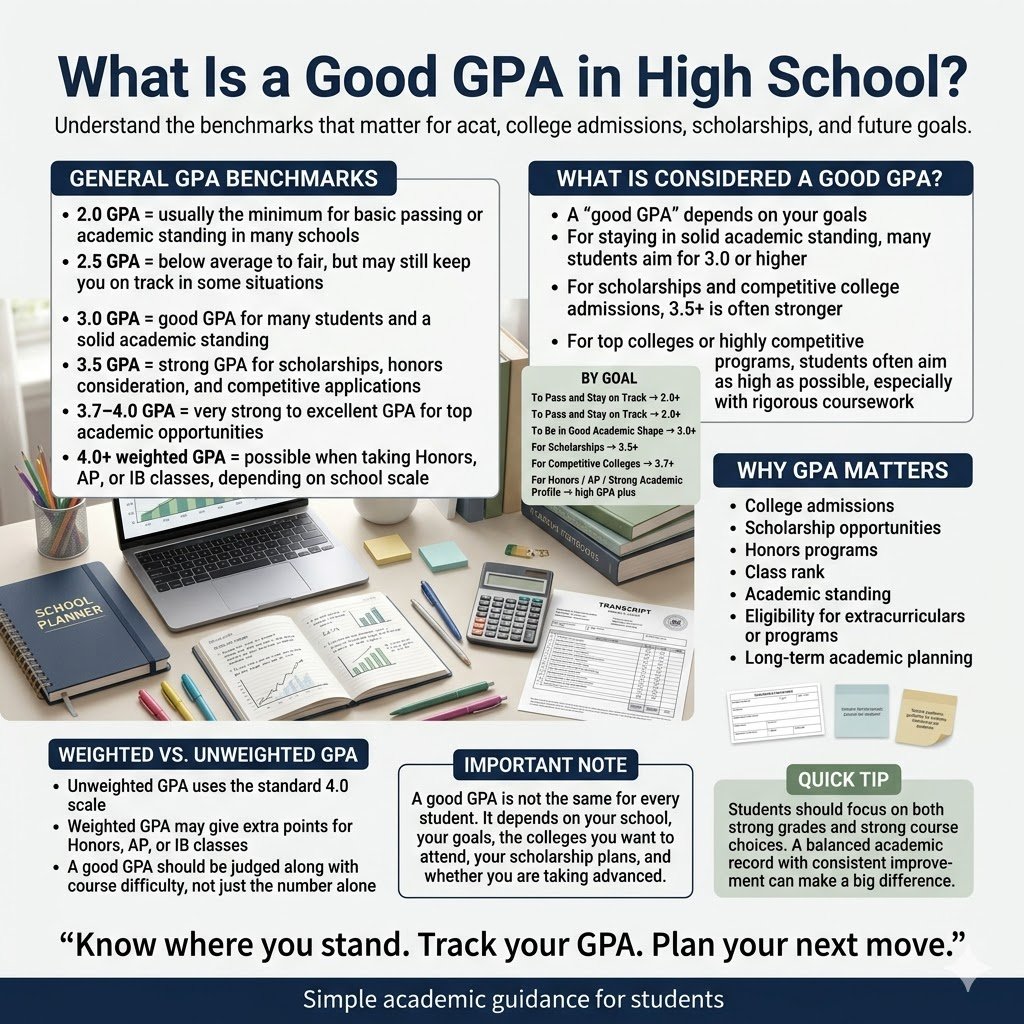
What Is a Good GPA in High School?
“Good” depends entirely on what you’re working toward. Here’s how to benchmark your GPA against the most common goals:
For General College Admissions
The average high school GPA in the United States is approximately 3.0 (a B average) on the unweighted scale. Students with a 3.0 gain admission to many solid colleges and universities and are often eligible for some scholarship opportunities.
- 2.5–3.0 GPA: Meets minimum admission requirements for most community colleges and many open-enrollment state universities.
- 3.0–3.5 GPA: Competitive for a broad range of four-year universities and eligible for many merit-based scholarships.
- 3.5–3.7 GPA: Competitive for selective state universities and many private colleges. Qualifies for Dean’s List recognition at most institutions. Strong eligibility for merit scholarships.
- 3.7–3.9 GPA: Highly competitive for selective universities. Qualifies for academic honors programs and top scholarship consideration.
- 3.9–4.0+ GPA (unweighted): Required for Ivy League and top-25 universities. The average GPA of students admitted to Ivy League schools is 4.0 or higher on the unweighted scale.
For Scholarships
Most merit-based scholarships set a minimum GPA requirement between 3.0 and 3.5. National Merit Scholarship consideration is linked to PSAT/NMSQT scores, but maintaining a competitive GPA is a prerequisite for the academic standing these programs expect. Scholarship eligibility typically uses your unweighted cumulative GPA from your official transcript.
For Class Rank
Class rank is determined by your school’s weighted or unweighted GPA relative to your graduating class, depending on district policy. A 3.9 weighted GPA might rank you in the top 10% at one school and the top 25% at another, depending on the overall academic profile of your class. Some high schools have moved away from class ranking entirely. Check with your school counselor to understand your school’s ranking policy.
Valedictorian status — the highest academic distinction a high school awards — is typically assigned to the student with the highest cumulative GPA in the graduating class. At schools that weight GPA, a student with multiple AP courses and an occasional B may be valedictorian over a student with a perfect unweighted 4.0 in all regular courses.
How AP, Honors, and IB Courses Affect Your GPA
Advanced courses affect your GPA in ways that are sometimes counterintuitive. Understanding the mechanics helps you make smarter course selection decisions.
Advanced Placement (AP) Courses
AP courses are college-level classes taught in high school. Most high schools assign a +1.0 bonus to AP course grades for weighted GPA calculation. An A in an AP course generates 5.0 weighted grade points; a B generates 4.0. This means that even earning a B in AP Physics contributes more to your weighted GPA than earning an A in a regular course.
However, because unweighted GPA treats all courses equally, taking AP courses and earning lower grades than you would in regular classes will lower your unweighted GPA. This is the AP dilemma: challenging yourself raises your weighted GPA and signals course rigor to admissions officers, but it may pull your unweighted GPA below what some schools or scholarships require.
The general guidance from most college counselors: take AP courses in subjects you’re genuinely strong in or passionate about, not purely to inflate your weighted GPA. Admissions officers read transcripts carefully — a student taking 8 AP courses and earning mostly C’s raises more concern than a student taking 3 AP courses and earning A’s and B’s.
Honors Courses
Honors courses are an intermediate level of difficulty between regular and AP. Most schools assign a +0.5 bonus for Honors sections in weighted GPA calculations. They offer less GPA risk than AP courses while still signaling course rigor on your transcript. For students not yet ready for AP-level content in a subject, Honors is often the smarter choice.
International Baccalaureate (IB) Courses
IB courses typically receive the same +1.0 bonus as AP courses in weighted GPA calculations, though some districts treat Standard Level (SL) and Higher Level (HL) IB courses differently. Full IB diploma candidates carry one of the most demanding course loads in high school, and admissions officers recognize this. An IB diploma on a transcript is treated as strong evidence of academic rigor regardless of the resulting GPA.
Dual Enrollment Courses
Dual enrollment — taking actual college courses while enrolled in high school — affects your GPA in two places: your high school transcript and your college transcript. Most school districts apply a weighting similar to AP/IB courses for dual enrollment GPA calculation, though this varies by district. Some apply a +1.0 bonus; others count dual enrollment on the unweighted scale.
Critically, dual enrollment grades are also recorded on your college transcript, which follows you permanently. A poor grade in a dual enrollment course doesn’t just affect your high school GPA — it becomes part of your college academic record. Always confirm your district’s dual enrollment GPA policy with your school counselor before enrolling.
The AICE Program
The Advanced International Certificate of Education (AICE), offered by Cambridge Assessment International Education, is another advanced curriculum recognized at many Florida and select national institutions. AICE courses typically receive the same weighting as AP and IB courses on a 5.0 scale, though state and district policies vary.
High School GPA and College Admissions: What Admissions Officers Really See
When a college admissions officer opens your application, your GPA is one of the first numbers they see — but it’s rarely the only thing they evaluate. Understanding what happens to your GPA in the admissions process prevents costly misunderstandings.
Colleges Recalculate Your GPA
Most selective colleges do not accept your school-reported GPA at face value. They recalculate it using their own methodology, often stripping out non-core electives, applying consistent weighting rules, or reviewing only grades from 10th and 11th grade. The GPA number you’ve been tracking on your report card may differ meaningfully from the GPA a specific admissions office arrives at.
The Common Application asks you to self-report your GPA and your school’s GPA scale — but the college will verify this against your official transcript. Inaccuracies in self-reported GPA are flagged. Always report your GPA exactly as it appears on your most recent official transcript, using your school’s official scale.
Course Rigor Matters as Much as the Number
A NACAC report consistently finds that grades in college prep courses are among the top five factors in college admission decisions. Admissions officers don’t just look at your cumulative GPA — they assess the trajectory of your grades across four years, the rigor of your course load relative to what your school offers, and how you performed in subjects related to your intended major.
A student applying to engineering programs with a 3.6 GPA and strong AP Calculus and AP Physics grades will often outperform an applicant with a 3.8 GPA who never attempted a math course above Algebra II.
GPA for Early Decision and Early Action
If you’re applying Early Decision (ED) or Early Action (EA), your application is reviewed before your senior-year grades are available. This means your academic case rests almost entirely on your freshman-through-junior grades and your senior-year course schedule. A strong cumulative GPA through junior year is especially important for ED/EA applicants. There is no opportunity to supplement with a strong senior fall semester before the admissions decision is made.
The UC GPA: A Special Case
For students applying to University of California campuses, your UC-calculated GPA is distinct from your school-reported GPA. The UC system:
- Counts only a–g required courses (specific UC-approved academic subjects).
- Includes only grades from 10th and 11th grade (9th grade is excluded).
- Caps weighted bonus points at 8 semesters of UC-approved AP/IB courses.
- Uses its own maximum cap of 5.0 for weighted GPA.
Many students are surprised to find their UC GPA is significantly different — sometimes higher, sometimes lower — than the cumulative GPA on their high school transcript. The UC GPA calculator on this site handles this calculation automatically when you select the UC-specific calculation option.
High School GPA for NCAA Athletic Eligibility
For student-athletes planning to compete at the college level, GPA carries consequences well beyond college admissions. The NCAA has its own academic eligibility requirements that are entirely separate from college admission — and meeting them is a prerequisite for competing and receiving athletic scholarships in Division I and Division II programs.
How NCAA Core GPA Works
The NCAA does not use the GPA listed on your high school transcript. Instead, the NCAA Eligibility Center calculates a separate core GPA using only grades earned in NCAA-approved core courses — specific subjects in English, Math, Natural/Physical Science, Social Science, Foreign Language, Comparative Religion/Philosophy, and additional approved academic subjects.
Core GPA is calculated on the unweighted 4.0 scale. Plus and minus grades are not used — a B+ and a B− both count as 3.0 in NCAA core GPA calculations. Weighted bonus points for AP and Honors courses do not apply.
NCAA GPA Requirements by Division
| Division | Minimum Core GPA | Additional Requirements |
|---|---|---|
| Division I (Full Qualifier) | 2.3 GPA | 16 NCAA-approved core courses; sliding scale with test scores |
| Division II (Full Qualifier) | 2.2 GPA | 16 NCAA-approved core courses |
| NAIA | 2.0 GPA | Top 50% of graduating class OR minimum test scores |
For Division I, the core GPA and SAT/ACT score operate on a sliding scale — a higher core GPA allows for a lower test score, and vice versa. The minimum floor is a 2.3 GPA with qualifying test scores.
The 10/7 Rule: Why Junior Year Is Critical for Student-Athletes
For Division I eligibility, the NCAA requires that 10 of your 16 core courses be completed before the start of your 7th semester of high school (the beginning of senior year). Seven of those 10 courses must be in English, Math, or Natural/Physical Science — the “7 of 10” rule.
Once senior year begins, those 10 courses are locked in — you cannot replace or repeat them to improve your NCAA core GPA. This means that if you earned a D in a core English course freshman year, you have until the end of junior year to retake it. After that, the grade is permanent in your NCAA eligibility calculation, regardless of what your high school’s grade replacement policy says.
Every student-athlete should register with the NCAA Eligibility Center (eligibilitycenter.org) by the end of sophomore year and track their core course GPA independently from their school GPA. These are two different numbers, and many student-athletes are declared academically ineligible each year because they didn’t know that until it was too late.
High School GPA for Scholarships and Financial Aid
Your cumulative GPA is a determining factor in nearly every merit-based scholarship available to high school students.
National Merit Scholarship: While selection begins with PSAT/NMSQT scores, National Merit Semifinalists and Finalists are evaluated holistically, with academic record — including GPA — as a key component of the review.
State and institutional scholarships: Most state scholarship programs (such as Georgia’s HOPE Scholarship, Florida Bright Futures, or Tennessee Promise) set specific minimum GPA requirements — often 3.0 to 3.7 — that must be maintained both in high school and, later, in college. Falling below the minimum GPA threshold can result in scholarship suspension or termination.
Private merit scholarships: The majority of private, organization-based, and corporate scholarships require a minimum GPA of 3.0, with competitive awards typically requiring 3.5 or higher. Many scholarship applications ask for both your unweighted and weighted GPA, so knowing both numbers before you apply is essential.
Financial aid: While federal need-based financial aid (FAFSA) does not have a GPA requirement for initial eligibility, many institutional grants and work-study awards have minimum academic standing requirements. Students on academic probation (typically below a 2.0 cumulative GPA) may have institutional aid suspended.
How to Raise Your High School GPA: Practical Strategies
Whether you’re recovering from a rough start or trying to push from a 3.5 to a 3.8, the math of GPA recovery is the same — and this calculator can help you model exactly what’s needed.
Understand the Math First
Your cumulative GPA becomes harder to move as you accumulate more credits. As a freshman with 5 courses completed, one A can shift your GPA significantly. As a junior with 30 courses completed, that same A moves the needle far less. Use the GPA predictor feature to calculate exactly what semester GPA you need to reach your target cumulative GPA.
Prioritize Your Core Subjects
Colleges — and the NCAA Eligibility Center — pay special attention to grades in English, Math, Science, Social Studies, and Foreign Language. Strong grades in these core academic areas do double duty: they raise your cumulative GPA and strengthen the specific academic profile that selective programs evaluate. If time and energy are limited, these are the subjects to protect first.
Use Grade Replacement Policies Wisely
Some school districts allow students to retake a course, with the higher grade replacing the original in the GPA calculation. This is one of the most efficient tools for GPA recovery, particularly for a failed or near-failed core course. However, grade replacement policies vary widely — some schools replace the original grade entirely, others show both grades on the transcript. Confirm your school’s policy with your school counselor before banking on grade replacement as a GPA strategy.
Be Strategic About Course Selection
Adding AP and Honors courses boosts your weighted GPA — but only if you earn strong grades. Taking on more advanced coursework than you can manage does not help your GPA on either scale and may actually reduce your admissions competitiveness by producing a pattern of low grades in high-rigor courses. The best course of action is to challenge yourself in subjects where you’re genuinely strong, and to use Honors as an intermediate step before AP in subjects where you need more preparation.
Seek Academic Support Early
One of the most consistent findings in academic performance research is that students who seek help early — through tutoring, study groups, teacher office hours, or academic support programs — recover from academic difficulty far more effectively than students who wait until grades have already collapsed. Your school counselor can connect you with available academic resources. Don’t wait for a report card surprise to act.
Manage Your Course Load and Extracurricular Commitments
A student carrying 7 AP courses while captaining a varsity sport and leading two student organizations is at real risk of GPA damage from overcommitment. Admissions officers are experienced at distinguishing between students who challenged themselves thoughtfully and students who spread themselves too thin. A slightly lower number of AP courses with consistently high grades is more competitive than a transcript of 8 AP courses with mediocre performance.

Percentage to GPA Conversion: What If My School Uses Percentages?
Some high schools issue percentage grades (0–100%) rather than letter grades. To use this calculator, convert your percentage grades using the standard conversion scale below:
| Percentage | Letter Grade | Unweighted GPA |
|---|---|---|
| 97–100% | A+ | 4.0 |
| 93–96% | A | 4.0 |
| 90–92% | A− | 3.7 |
| 87–89% | B+ | 3.3 |
| 83–86% | B | 3.0 |
| 80–82% | B− | 2.7 |
| 77–79% | C+ | 2.3 |
| 73–76% | C | 2.0 |
| 70–72% | C− | 1.7 |
| 67–69% | D+ | 1.3 |
| 65–66% | D | 1.0 |
| Below 65% | F | 0.0 |
Note that percentage-to-letter grade cutoffs vary by school. Some schools define an A as 90–100%; others begin at 93%. Use your school’s official scale for accuracy.
Common High School GPA Questions Answered
Does freshman year GPA count toward your high school GPA? At most schools, yes — grades from 9th grade through 12th grade all count toward your cumulative GPA. A small number of districts and some individual colleges exclude freshman-year grades from their calculations, but it’s the exception, not the rule. Never assume freshman year grades will be dropped — verify your school’s policy with your counselor.
Can my weighted GPA go above 4.0? Yes. Weighted GPA can exceed 4.0 because AP, IB, Honors, and dual enrollment courses receive bonus grade points above the standard 4.0 maximum. Students with multiple advanced courses can achieve weighted GPAs of 4.5 or higher. Some districts using a 6.0 scale for dual enrollment courses allow even higher weighted GPAs. The theoretical maximum on a 5.0 weighted scale is 5.0.
What is the difference between semester GPA and cumulative GPA? Semester GPA measures your academic performance in a single term. Cumulative GPA aggregates all grades across every completed semester — it’s the number that appears on your official transcript and is used in college admissions, scholarship applications, and NCAA eligibility determinations. Your cumulative GPA is not simply the average of your semester GPAs; it’s the total quality points from all semesters divided by total credits attempted across all semesters.
How do colleges recalculate my high school GPA? Each college uses its own methodology. Most will review your official transcript, identify core academic courses, and calculate a GPA using their own grade scale — which may or may not apply the same weighting your high school used. The UC system, for example, uses only 10th and 11th grade core course grades. Some colleges recalculate entirely on a 4.0 unweighted scale regardless of your school’s weighting. This is why the GPA number on your transcript is a starting point, not the final word.
Does dual enrollment affect my high school GPA? Yes, but how depends on your school district’s policy. Most districts apply a weighting similar to AP/IB courses for dual enrollment grades. More importantly, dual enrollment grades are also recorded permanently on your college transcript, which follows you into your undergraduate and graduate career — separate from and in addition to their impact on your high school GPA.
What is the average high school GPA in the United States? The average unweighted GPA for U.S. high school students is approximately 3.0. This national average has risen modestly over recent decades. Students planning to apply to selective colleges should aim for a GPA meaningfully above the national average, as competitive applicant pools at top schools typically have unweighted GPAs of 3.7 and higher.
Is a 3.5 GPA good in high school? A 3.5 unweighted GPA is considered strong by most standards. It puts you in a competitive position for the majority of four-year universities, qualifies you for many merit-based scholarships, and demonstrates consistent academic performance. For highly selective colleges (top 25 national universities), a 3.5 unweighted GPA may fall below the typical admitted student profile, where 3.7–3.9+ is more common. A 3.5 with strong AP/Honors course rigor is generally more competitive than a 3.5 in all regular courses.
What GPA is needed for NCAA Division I eligibility? NCAA Division I requires a minimum 2.3 core GPA calculated on 16 NCAA-approved core courses, using the unweighted 4.0 scale. This minimum operates on a sliding scale with your SAT/ACT score. A higher core GPA allows for a lower test score, and vice versa. Student-athletes should register with the NCAA Eligibility Center and track their core GPA separately from their school GPA — these are calculated differently and may produce significantly different numbers.
What GPA is valedictorian? Valedictorian is awarded to the student with the highest cumulative GPA in the graduating class, using whatever GPA scale the school uses (weighted or unweighted, depending on district policy). There is no universal GPA threshold for valedictorian — it’s a relative ranking, not an absolute score. In competitive academic environments with many students taking AP and Honors courses, the weighted GPA of the valedictorian often exceeds 4.5.
Final Thoughts: Track Your GPA Before It Matters
The students who consistently reach their academic and college admissions goals are the ones who track their GPA proactively — not reactively. Waiting for a report card to reveal a problem means losing a semester of recovery time. Knowing your semester GPA and cumulative GPA in real time, modeling what grades you need to hit your target, and understanding how AP, Honors, and dual enrollment courses affect both your weighted and unweighted average puts you in control of one of the most consequential numbers of your academic career.
Use this high school GPA calculator to stay ahead of your transcript — not just react to it.
This calculator uses the standard U.S. 4.0 unweighted scale and the most widely adopted weighting values (+0.5 for Honors, +1.0 for AP/IB/Dual Enrollment). Grading scales, weighting systems, and GPA policies vary by school district. Always verify your school’s official grade scale and course weighting in your student handbook or with your school counselor. NCAA eligibility calculations are estimates only — official determinations are made by the NCAA Eligibility Center using your official transcript.